Karwar: Future wars cannot be fought by individual military services, Air Chief Marshal A P Singh said on Wednesday, underscoring the need for greater jointness among the armed forces.
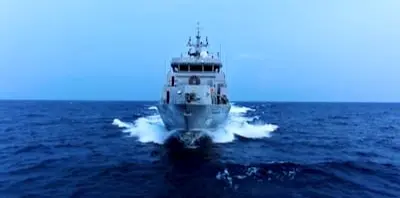
He was speaking after the commissioning of INS Malvan, the second of the Mahe-class Anti-Submarine Warfare Shallow Water Craft (ASW-SWC), at the Indian Navy base at Karwar.
Military technologies must be developed at a pace that keeps them relevant as “technology delayed is technology denied”, the Indian Air Force (IAF) chief said.
He also called for faster progress towards self-reliance in the aviation sector, particularly referring to the Indian Air Force (IAF), as reported by Deccan Herald.
“No future war is going to be fought by an individual service. All of us, whether we are in blues (IAF), whites (Navy), or OGs (Olive Green of the Army), or whichever colour, whether we are in allied services, we all have to fight together as one nation, and then only we will succeed,” he said.
The momentum that this collective mission has gained over the last four to five years, particularly after the creation of the Chief of Defence Staff post, will continue to grow stronger, Air Chief Marshal Singh said.
“All of us will move forward together and bring greater glory to the nation,” he said.
Among the others who attended the commissioning ceremony was Vice Admiral Sanjay Vatsayan, Flag Officer Commanding-in-Chief, Western Naval Command and senior naval officers, veterans as well as representatives of Cochin Shipyard Ltd.
“We all understand how important maritime security and the maritime power for India’s growth are. Because any nation, they say, the maritime routes decide your trade and your trade decides your destiny. And as far as India is concerned, we all understand how important the Indian Ocean region is to us.” He said the Indian Navy has been playing a vital role in securing sea lines of communication and ensuring that Indian trade and economic growth continue unhindered,” the air chief said.
ACM Singh did not mention the ongoing US-Iran conflict by name, but said that developments around the world in recent times have strengthened the belief that no country can succeed unless it has secure sea lines of communication and free trade.
The Navy had made significant progress in indigenous shipbuilding and expressed hope that the aviation sector would emulate the model, he said, referring to the government’s thrust on self-reliance.
“I just hope that the other two services, especially the Indian Air Force, learn the lesson as to how the Indian Navy has been able to get this whole concept right, where you have your Indian Navy officers who are embedded in your shipbuilding right from the beginning,” he said.
These people grow up in the same chain and become even the seniormost in those shipyards, ACM Singh noted.
“And even after retirement, they continue to render the services. Something similar, I think, the Indian Air Force has to adopt to make sure that even in the aviation sector, our self-reliance, our dream of being self-reliant becomes a reality and becomes a reality soon,” he said.
The IAF was steadily moving closer to achieving its dream of self-reliance, he said.
“The Indian Navy adopted this vision of self-reliance very early on. In fact, it is we who took longer, because different sectors require different amounts of time to develop,” he added.
INS Malvan has around 80 per cent indigenous content by value, which reflects the success of the ‘Atmanirbhar Bharat’ initiative, the air chief said.
The country was moving closer towards the goal of self-reliance, adding that while some components still needed to be sourced or co-produced abroad, those gaps would eventually be bridged, he added.
ACM Singh emphasised the importance of indigenous research and development, saying that military technologies must be developed at a pace that keeps them relevant.
“If you are growing at a speed that by the time you design and develop something, by the time you produce something, the world has moved over to a new technology, then that has no meaning. According to me, any technology delayed is technology denied,” he said.
The growth of indigenous R&D (research and development) and production capabilities was encouraging, though the country still had some distance to cover before achieving its targets, he said.
Praising the Navy for inducting its seventh warship this year, he said how Karwar was one of the world’s most modern naval bases and a symbol of India’s maritime strategic vision under Project Seabird, an ambitious naval infrastructure initiative.