New Delhi: Congress-led protests against Chief Election Commissioner Gyanesh Kumar escalated on Monday, with party workers targeting his residence in Agra and Opposition parties staging demonstrations in several cities over the functioning of the Election Commission of India (ECI).
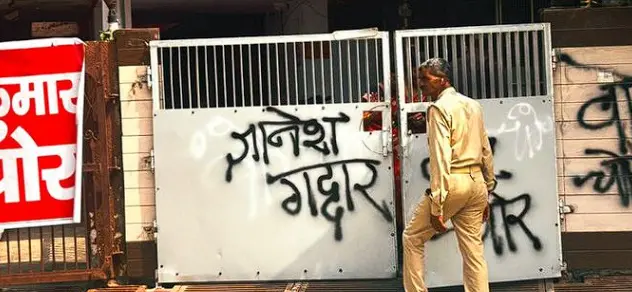
A large group of Congress workers and members of affiliated organisations gathered outside Kumar’s home in Vijay Nagar, Agra, during the morning. They raised slogans against the CEC, put up stickers and pasted pamphlets outside the residence.
Property Defaced
Some protesters also allegedly defaced the property by spray-painting the words “Gyanesh Gaddar Gyanesh Chor” on the main gate and a wall. The slogan describes Kumar as a “traitor” and a “thief”. Videos and photographs showing the protest and the alleged vandalism were later circulated on social media.
This besides, Congress workers held similar demonstrations in Delhi, Madhya Pradesh, Jammu and Kashmir, Telangana and several other states and Union Territories. The protests were organised to demand Kumar’s resignation amid the political controversy over the ECI’s handling of the Special Intensive Revision (SIR) of electoral rolls, as reported by The Statesman.
Venugopal Attacks Poll Panel
AICC general secretary KC Venugopal defended the protests, calling them a “natural reaction from the people of this country against the CEC and his anti-constitutional, illegal activities to destroy democracy.”
“The CEC bypassed the observations of the 2 Election Commissioners and this makes it clear that he was conspiring with the PM and HM to sabotage Indian democracy,” he stated.
Venugopal was referring to a report by The Indian Express, which said Election Commissioners Sukhbir Singh Sandhu and Vivek Joshi had raised objections to several decisions and orders connected with the SIR exercise.
According to the report, the two Election Commissioners had recorded objections 14 times over a period of 10 months. The reported concerns related to aspects of electoral-roll revision, voter registration, deletion of names, changes to Form 6 and the handling of electoral data.
The report has intensified the political dispute surrounding the poll panel. Opposition parties have questioned the ECI’s internal functioning, sought greater transparency and alleged that decisions were being taken without adequately addressing the concerns of the other Election Commissioners.
Plea Challenges CEC’s Authority
Meanwhile, a fresh petition was filed in the Supreme Court challenging the manner in which the ECI’s constitutional powers are allegedly being exercised. The plea questions whether Gyanesh Kumar can independently exercise or represent powers that are vested in the Commission as a multi-member constitutional body.
The writ petition, filed under Article 32 by public-spirited citizen Rakesh Kumar Singh alias Rakesh Singh, seeks directions to enforce the collective decision-making structure of the ECI. It also seeks a writ in the nature of quo warranto questioning the authority under which the CEC allegedly acted in the name of the poll panel.
The petitioner has argued that Article 324 of the Constitution assigns the superintendence, direction and control of elections to the “Commission”, rather than to an individual Chief Election Commissioner.
The plea further cites Section 18 of the Chief Election Commissioner and Other Election Commissioners (Appointment, Conditions of Service and Term of Office) Act, 2023. The provision lays down a collective decision-making process and states that issues on which the members disagree must be resolved by majority.
“This petition concerns not the fortunes of any individual constitutional functionary, but the constitutional identity of the Election Commission of India (ECI) itself,” the plea said.