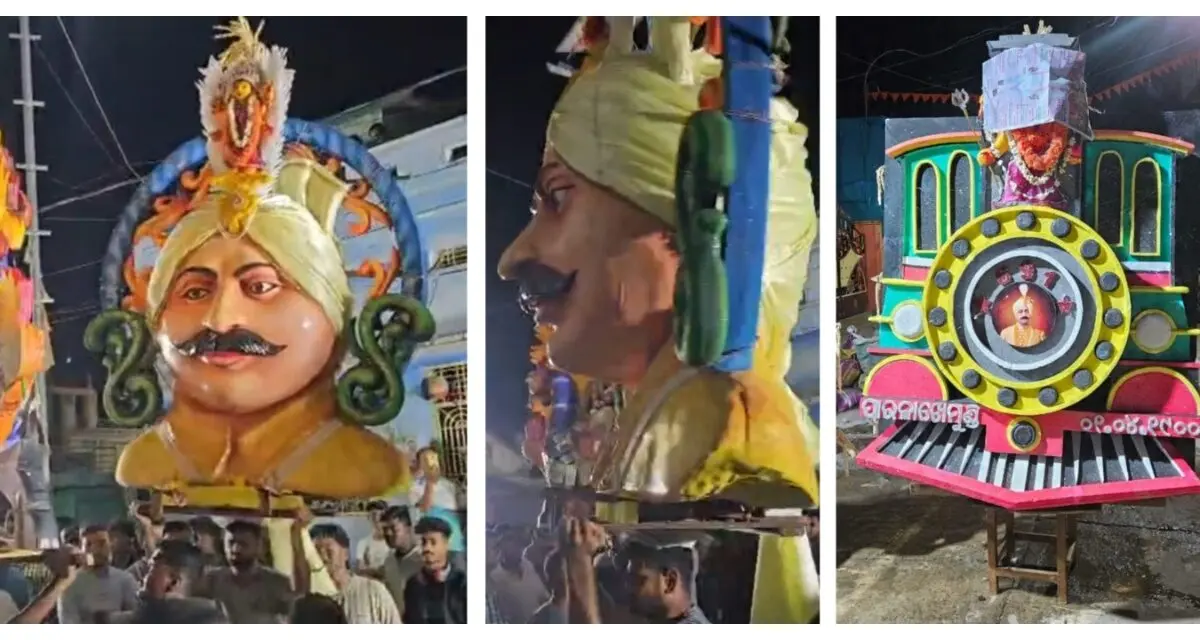
Berhampur: In a splendid confluence of faith, folklore, and festivity, the historic town of Paralakhemundi in Odisha’s Gajapati district once again resonated with devotional fervour as the age-old Gaja Muhan Puja was observed with grandeur throughout the sacred month of Chaitra.
Celebrated on four consecutive Tuesdays—March 10, 17, 24, and 31—this cherished tradition continues to weave together the spiritual and cultural fabric of the region.
Steeped in a legacy spanning over 160 years, the origins of Gaja Muhan are deeply intertwined with the haunting memories of the ‘Na-Anka Durbhikshya’, one of the most devastating calamities in Odisha’s history that claimed over a million lives. Historians recount that amidst the despair of famine and disease, divine intervention came through dreams, urging devotees to worship Goddess ‘Maa Kadambakhandi’—revered as Adi Shakti—for salvation from hunger and suffering. This gave rise to a tradition that has since blossomed into a vibrant annual celebration.
Another popular legend narrates how the Hadapa Brahmin family, afflicted by disease and loss, received divine guidance from the deity of Katika Street. Acting upon this celestial command, they initiated the worship and the sacred Nagar Yatra of Gaja Muhan, which gradually extended beyond Katika Street to envelop the entire town in devotion.
The festival’s unique identi
ty lies in its artistic and ritualistic expressions. Crafted meticulously from khaee (puffed rice) and guda (jaggery), the Gaja Muhan structures—ranging from three to five feet in height—are adorned with colourful papers, coconut flowers, and the image of the presiding deity.
As dusk descends on Tuesdays, young devotees, after ritual purification with turmeric water, lift the sacred effigy onto their heads and dance through the night in joyous reverence. The celebration culminates at dawn with the ceremonial immersion (bisarjan), marking the cyclical rhythm of devotion.
From its humble beginnings at Kabichandra Street—where the first offering of ‘Pana’ is made—the festival now flourishes across various localities including Odia Bhandari Street, Rani Padmavati Street, Palace Street, and Big Brahmin Street. Each lane transforms into a corridor of colour, music, and spiritual exuberance.
A highlight of the festivities is the grand town parikrama of Maa Kadamkhandi’s Gaja Muhan from Katika Street, often accompanied by traditional performances and cultural displays.
This year, the celebration gained added significance as it showcased the legacy of Parala Maharaja, the loco of the Parlakimidi Light Railway (PLR) which rolled Naupada to Paralakhemundi 126 years ago on April 1, 1900, on the eve of Odisha Day, blending historical pride with devotional zeal.
More than a ritual, Gaja Muhan stands as a living testament to Paralakhemundi’s enduring heritage—a festival where artistry meets spirituality, and where generations unite in collective celebration. As housewives, artisans, and youth contribute their creativity and devotion, the festival continues to illuminate the cultural soul of the Gajapati district, carrying forward a luminous tradition through time.