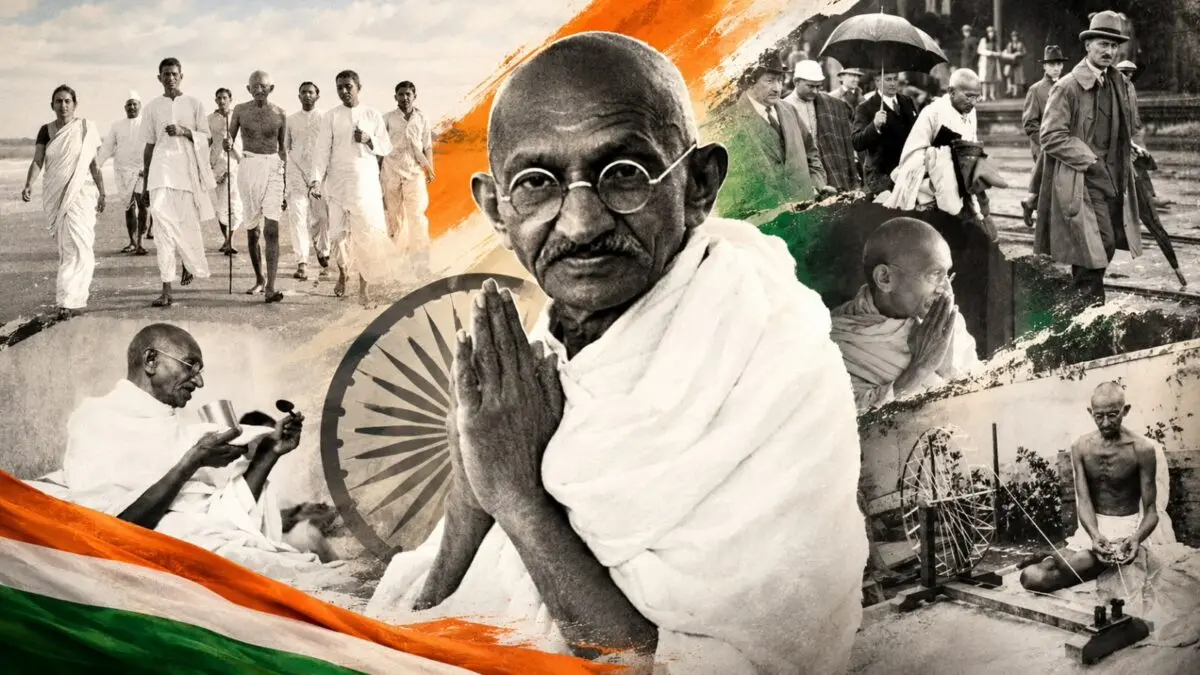
Bhubaneswar: As India observes Gandhi Jayanti today (October 2), Mahatma Gandhi is being remembered for his pivotal role in India’s freedom struggle and his philosophy of nonviolence. But there is much more to Gandhi’s life than his leadership of the independence movement.
From his experiments with food and his early marriage to his views on government, religion and vegetarianism, several lesser-known aspects of Gandhi’s life offer a different glimpse into the man behind the iconic image. Here are 20 interesting facts about Mahatma Gandhi that go beyond his role in India’s freedom struggle.
- Gandhi was not born with the title ‘Mahatma’
Mahatma Gandhi was born Mohandas Karamchand Gandhi on October 2, 1869. Karamchand was his father’s name. The honorific Mahatma, meaning “Great Soul”, was given to him in 1914.
- He was affectionately called ‘Bapu’
In India, Gandhi is often referred to as Bapu, a term of affection that means “father.”
- His causes extended beyond independence
Gandhi’s concerns went far beyond ending British rule. He campaigned for women’s civil rights, the abolition of the caste system and equal treatment for people of all religions. His mother and father also came from different religious traditions.
- He fasted in support of the ‘untouchables’
Gandhi advocated fair treatment for the people then regarded as “untouchables”, who were at the bottom of India’s caste hierarchy. He undertook several fasts in support of the cause and referred to them as Harijans, meaning “children of God.”
- Gandhi spent years experimenting with his diet
Gandhi was known for his experiments with food. For five years, he ate mainly fruit, nuts and seeds before returning to strict vegetarianism after experiencing health problems.
He believed people should discover the diet that suited them best. Over the years, he recorded his food experiments and adjusted his diet accordingly. He also wrote a book titled The Moral Basis of Vegetarianism.
- He travelled with a goat for fresh milk
Gandhi had taken an early vow to avoid milk and milk products, including ghee. However, when his health deteriorated, he eventually began drinking goat’s milk.
At times, he even travelled with his goat so that he could ensure the milk was fresh and that he would not be given cow or buffalo milk.
- Nutritionists studied how he could fast for 21 days
Gandhi’s prolonged fasts were so remarkable that government nutritionists were brought in to examine how he could survive for 21 days without food.
- The British restricted official photographs of his fasts
During Gandhi’s hunger strikes, the British government did not permit official photographs of him while he was fasting. Officials feared that images of his fasts could further strengthen the independence movement.
- Gandhi believed in philosophical anarchism
Despite becoming one of the most influential political figures of his time, Gandhi was a philosophical anarchist. He envisioned a society without an established government, believing that people could govern themselves if they embraced nonviolence and followed a strong moral code.
- Winston Churchill was one of his prominent critics
Gandhi had many political opponents, and Winston Churchill was among his most outspoken critics.
- He was married at just 13
Gandhi entered into an arranged marriage when he was 13 years old. His wife, Kasturbai Makhanji Kapadia, was a year older than him. The couple remained married for 62 years.
- Gandhi’s walk
Even at the age of 70, he walked about 18-km a day.
- He recruited Indians to fight for Britain during World War I
Gandhi’s commitment to nonviolence is well known, but during World War I, he actually recruited Indians to fight for Britain. His position changed during World War II, when he opposed India’s involvement in the conflict.
- Kasturba died while imprisoned
Gandhi’s wife, Kasturba, died on February 22, 1944, while imprisoned at the Aga Khan Palace. Gandhi was also imprisoned there at the time.
Her death anniversary is celebrated as Mother’s Day in India. Gandhi was released from prison only after contracting malaria, as British officials feared that his death in custody could trigger an uprising.
- Gandhi studied law in London
Gandhi attended law school in London. Despite becoming a highly influential writer and speaker, he was reportedly known among the faculty for his poor handwriting.
- His image has appeared on Indian currency since 1996
The image of Mahatma Gandhi has appeared on all denominations of Indian rupee notes printed since 1996.
- He spent 21 years in South Africa
Before becoming the central figure in India’s independence movement, Gandhi spent 21 years in South Africa, where he was also imprisoned several times.
- Gandhi did not want a ‘Gandhism’
Gandhi rejected the idea of creating a formal doctrine around his name and did not want a cult-like following.
- Gandhi’s tryst with music
While staying in London, Gandhi started learning to play violin and dance, besides elocution. But, he soon realised that these things didn’t interest him and so he quit.
- One of Gandhi’s ash urns is in Los Angeles
An urn that once contained Mahatma Gandhi’s ashes is now kept at a shrine in Los Angeles, California.