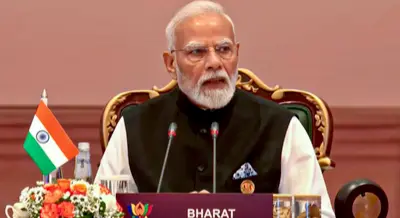
New Delhi: Prime Minister Narendra Modi welcomed world leaders, including Russian president Vladimir Putin and Chinese president Xi Jinping, to India for the two-day BRICS Summit 2026 on Saturday.
In his opening address, PM Modi said India’s BRICS chairship had followed a “people-centric and humanity-first approach”, with resilience, innovation, cooperation and sustainability identified as key priorities.
“This year’s Brics Summit marks a historic milestone as we celebrate the 20th anniversary of Brics. In human life, the age of 20 marks the beginning of a new phase of maturity and responsibility. It is a stage when responsibilities are added to dreams and capabilities are given a new direction,” the Prime Minister said.
Reiterating India’s stand on peace and collaboration, he spoke on how the organisation connected with common people.
“India’s BRICS chairship is based on a people-centric and humanity-first approach. Resilience, innovation, cooperation and sustainability have been our priorities. With these priorities, we have placed special emphasis on connecting the BRICS chairship with the common people. With this vision, more than 350 meetings were organised, and we had the opportunity to welcome your teams in nearly 30 cities,” PM Modi said.
“Today, BRICS, too, is at its coming-of-age moment. Over the past 20 years, BRICS has established a distinct identity on the global stage. We respect each other’s perspectives and move forward through consensus. We are not against anyone; rather, we seek to move forward with the approach of taking everyone along,” he added.
Speaking on reform in the United Nations Security Council for greater participation of the Global South, PM Modi pointed to how it continues to remain back benchers when it comes to decision making.
“Reform in UNSC cannot be delayed anymore. Global South must become a rule-shaper. The current structure of global governance appears like a pyramid. At the top, power and decision-making are concentrated, while at the bottom are countries that are affected by these decisions but have little role in shaping them. The Global South is today on the frontlines of global crises, but in the back row when it comes to decision-making,” he said.
He also spoke on the creation of a secure digital repository to record all developments.
“I propose a BRICS continuity and implementation mechanism. Under this, all initiatives and outcomes can be followed up through the Troika. We can create a secure digital repository where, along with every decision, the nodal point, timeline and implementation status can be recorded. Friends, while strengthening BRICS, we must also chart the course for global reform,” the Prime Minister said.
“For the next 20 years, we need to work on a new and ambitious agenda. We must begin this with our own working system. The BRICS chairship changes every year, but this should not cause our institutional momentum to slow down. Friends, the message from this BRICS Summit being hosted by India should be clear. If our future is shared, the right to shape that future should also be shared. From voice to impact, from privilege to partnership, this should be the guiding resolve of BRICS at present,” he added as reported by The Times of India.
Meanwhile, in a major diplomatic breakthrough, the BRICS nations have reached a consensus on a Joint Statement following intensive negotiations that continued until 4 am on Saturday. The statement is expected to be issued during the summit later today.
The negotiations involved differences over several contentious issues, with India leading sustained consultations to bridge competing positions and build consensus among member countries.