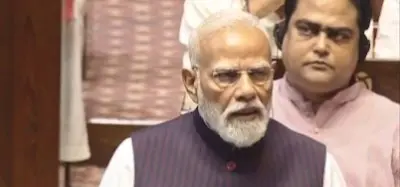
New Delhi: While the fundamentals of the Indian economy remain strong, the government is working on a strategy for the short, medium, and long term to handle the crisis arising from the conflict in the Middle East, and has also formed an inter-ministerial group, Prime Minister Narendra Modi told the Rajya Sabha on Tuesday.
The PM also highlighted the government’s initiative to build ships in the country, in an effort to reduce dependence on foreign vessels.
The government has allocated Rs 70,000 crore to build ships under the ‘Make in India’ initiative, he said at a time when global trade and supply chains have been disrupted.
“The government has allocated Rs 70,000 crore for building ships under the ‘Make in India’ initiative,” Prime Minister Modi said, adding that there is no option but for India to become self-reliant in a rapidly changing global environment.
“The current situation has impacted the global economy. However, the fundamentals of our economy remain strong. The government is working on a strategy for the short, medium, and long term, and has also formed an inter-ministerial group,” he added, as reported by News18.
The war in West Asia has created a serious global energy crisis and has disrupted routine supplies, particularly through the Strait of Hormuz, a key route for crude oil, gas and fertilisers, he pointed out.
“We are all aware of the ongoing war in West Asia and the serious situation arising from it. Today, I will present the government’s position before the House and the people of the country,” PM Modi said.
“This war has created a serious energy crisis across the world. It is also a matter of concern for India. This is disrupting our routine supplies. Many ships from around the world are stuck in the Strait of Hormuz, and several Indian crew members are on board, which is a matter of concern,” he said.
“Attack on ships at Hormuz is not acceptable. Our objective is de-escalation through dialogue and diplomacy. India’s continuous effort is to encourage all parties to reach a peaceful resolution at the earliest,” the Prime Minister added.
India is trying to ensure the safe movement of ships carrying essential supplies despite the conflict situation, he said.
“Through diplomacy, India is trying to ensure safe commutation of the country’s ships even in a war situation. India has opted for a solution through dialogue to resolve this issue,” the Prime Minister said.
India has been in continuous contact with key stakeholders in the region since the war began, he said.
“Since the beginning of this
war, I have held two rounds of talks with most of the heads of state in West Asia. We are in contact with Iran, Israel, and the United States,” the PM added.
“Any threat to human life in this war is not in the interest of humanity, so India is making constant efforts to encourage all sides to reach a peaceful solution as soon as possible,” he added.
The Prime Minister pointed out that nearly one crore Indians live and work in Gulf countries, making stability in the region critical for their safety and livelihoods. The government has prioritised the safety of Indians both within the country and abroad amid the crisis, he added.
“In crisis situations, both within the country and abroad, the security of Indians is our top priority. Since the war began, more than 3,75,000 Indians have safely returned to India. From Iran alone, more than 1,000 Indians have returned safely so far, including over 700 young people who were studying medicine,” he said.
“It is very unfortunate that due to the attacks, some Indians have lost their lives and some have also been injured,” the PM added.
He said India has strengthened its preparedness to deal with possible disruptions in global energy supply.
“India is making efforts to ensure that ships carrying oil, gas, and fertilisers reach the country safely. Today we import energy from 41 countries,” he said.
“In the past 11 years, 53 lakh metric tonnes of strategic oil reserves have been created, and work on an additional capacity of 65 lakh metric tonnes is ongoing,” Prime Minister Modi added.
“The country is working on arranging over 65 lakh metric tons of gas. Along with that, India’s refining capacity has also been increased in the past 10 years. I want to assure the country that India has enough crude oil storage and non-stop supply arrangements,” he said.
If the crisis persists for a longer period, serious consequences are likely for the global economy, he warned.
The Prime Minister, in the Lok Sabha, on Monday, had highlighted government measures to ensure fertiliser availability and stable electricity supply amid the crisis.
The government has made adequate arrangements for fertilisers to ensure sowing activities for the upcoming Kharif season are not impacted and that global disruptions will not burden farmers, he said.
“A major question is – what will be the impact of the war on agriculture? The farmers of our country have filled our grain reserves. Therefore, India has adequate food stocks. It is also our endeavour that sowing for the Kharif season takes place properly. The government has made adequate arrangements for fertilisers to deal with such situations,” the PM said.
Sufficient coal stocks are available at power plants to meet rising electricity demand during the summer season, he noted.
Prime Minister Modi had also said the government has constituted seven empowered groups to assess the evolving situation, similar to arrangements made during the Covid-19 period.