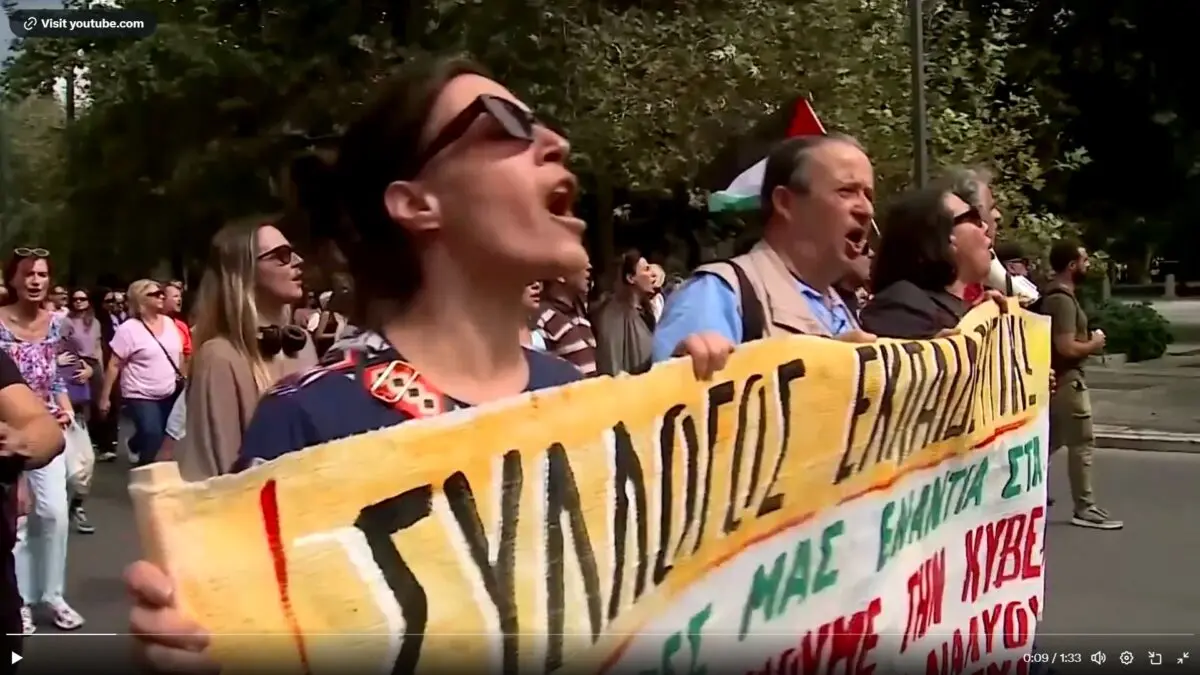
Athens: Athens was brought to a standstill on Wednesday as tens of thousands of workers walked off their jobs and poured into the streets to protest sweeping new labour reforms that critics warn would usher in 13-hour workdays and erode hard-won worker protections. The 24-hour general strike, called by Greece’s largest labour unions, paralysed transport networks, shut down public services and drew mass demonstrations across major cities, including Athens and Thessaloniki.
In the capital, taxis and trains did not run, ferries remained docked and commuters were left stranded as the metro, bus, tram and trolley systems operated only on a restricted timetable. Municipal services, schools, courts and public hospitals were also hit, forcing cancellations and delays. Similar scenes unfolded in Thessaloniki, where public life slowed sharply as protesters gathered in central squares, waving banners denouncing what they called “inhumane hours and miserable wages.”
At the centre of the uproar is a controversial labour bill introduced by Prime Minister Kyriakos Mitsotakis’ centre-right government, which allows working shifts to extend up to 13 hours in exceptional cases, though capped at 48 hours per week and 150 overtime hours per year. The government argues that the measure will bring “greater flexibility” to the labour market and insists the provision would only apply occasionally, no more than three times per month and up to 37 days annually.
Unions, however, reject the assurances, warning that the reform paves the way for worker exploitation under conditions of low wages and high unemployment. The private sector umbrella union, General Confederation of Workers of Greece (GSEE), declared: “We say no to the 13-hour (shift). Exhaustion is not development; human tolerance has limits.” The pro-communist union PAME went further, calling the plan “modern slavery” and demanding a reversal. Unions are pressing instead for a shorter 37½-hour working week and the restoration of collective bargaining rights dismantled during years of austerity.
The discontent has also tapped into broader frustrations. Many demonstrators waved Palestinian flags, chanting “free, free Palestine” in solidarity with the people of Gaza, merging Greece’s labour fight with global currents of protest. Others linked the labour law changes to the long legacy of economic crises and austerity programmes that have battered Greek workers, pointing to the country’s minimum wage of €880 per month, among the lowest in the European Union.
Despite the government’s claims that longer shifts would boost efficiency, labour experts caution that extended hours could worsen burnout, reduce productivity and raise the risk of workplace accidents. Critics also argue that the reforms ignore the social and health costs of prolonged workdays.
The strike marked one of the largest industrial actions in recent years, signalling a sharp escalation of tensions between workers and the Mitsotakis government. With the labour bill expected to be voted on later this month, unions have threatened to intensify protests if their demands are ignored.
As Greece shut down for a day, the clash between flexibility and protection, growth and exhaustion, played out on the streets with a message that reverberated beyond Athens: that the fight over work hours is, at its core, a fight over dignity, fairness and the future of labour in a country still grappling with the scars of crisis.