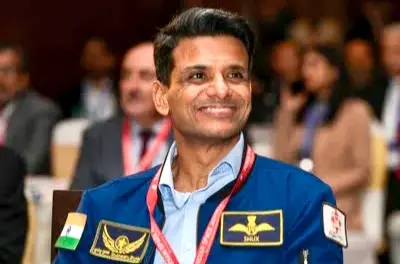
New Delhi: Group Captain Shubhanshu Shukla, the first Indian astronaut to have travelled to and spend time at the International Space Station (ISS) will be honoured with the prestigious Ashok Chakra.
He will be receiving the country’s highest peacetime gallantry award for extraordinary courage displayed during the historic Axiom Mission 4 (Ax-4) to the ISS, as reported by India Today.
This award recognises his pivotal role as mission pilot in June 2025 that inspired an entire generation of Indians to look deeper into space exploration.
Gp Capt Shukla was launched aboard SpaceX’s Dragon spacecraft “Grace” on June 25, 2025. His 18-day expedition involved over 60 scientific experiments, including seven led by the Indian Space Research Organisation (ISRO) that was part of the mission from the start.
As part of a multinational crew with astronauts from the US, Poland and Hungary, he navigated the high-stakes journey, docking with the ISS after 26 hours and cond
ucting vital research, bolstering India’s Gaganyaan programme slated for 2027.
The 39-year-old Indian Air Force (IAF)’s daring feats, piloting through orbital manoeuvres and managing microgravity operations, exemplified unparalleled bravery amid potential risks like system failures or re-entry hazards.
Prime Minister Narendra Modi, who celebrated the launch and the mission, speaking to Gp Capt Shukla personally during his stay at ISIS, praised Shukla for carrying the nation’s aspirations.
The fighter pilot from Shukla from Lucknow, selected for Gaganyaan in 2019, trained rigorously at Russia’s Yuri Gagarin Centre. He was only the second Indian to have travelled to space after Wing Commander Rakesh Sharma in 1984.
His mission involved a suite of complex experiments essential for future ISRO missions. He spearheaded research into space anaemia and cardiovascular health, monitoring how the human body reacts to prolonged weightlessness.
He also managed advanced materials’ science tests, focusing on the solidification of alloys in microgravity. Gp Capt Shukla also oversaw biological studies involving the growth of protein crystals, which are vital for drug development back on Earth.
The mission and the experiments provided critical data on life support systems, directly informing the safety protocols for India’s upcoming indigenous Gaganyaan launches.