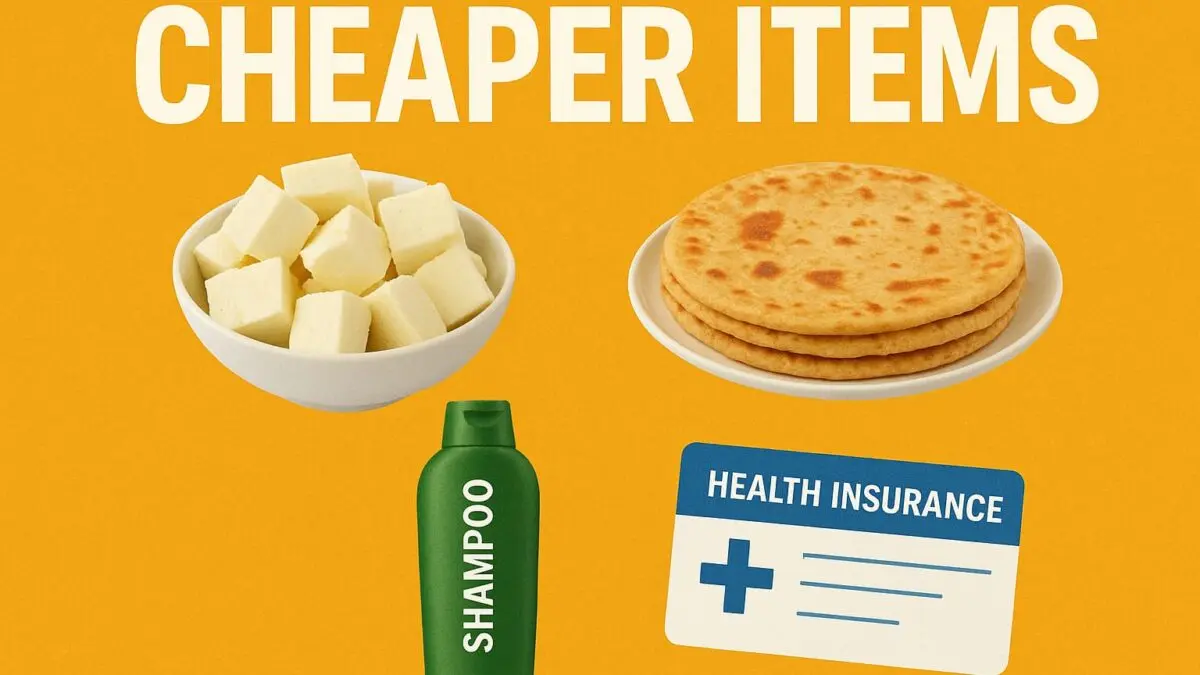
New Delhi: From frozen parathas and paneer to soaps, shampoos and even health and life insurance, the middle class household basket just became lighter with the GST Council announcing a sweeping rate cut on a host of essentials. The decision, hailed as one of the most comprehensive overhauls of the indirect tax system since GST was rolled out in 2017, is set to take effect from September 22 and is being seen as a major relief ahead of the festive season.
Everyday food staples such as ready-made parathas, chapatis, khakhra, pizza bread and paneer have been exempted from GST entirely, making them tax-free. UHT milk and paneer-based products too now fall in the zero-tax category, while soya and plant-based milk drinks have had their tax rate reduced to 5%.
Toiletries and personal care items that were earlier taxed at 18%—including toothpaste, soap, hair oil, shampoo, shaving cream and toothbrushes—will now attract just 5% GST, bringing down monthly expenses for households. Insurance premiums have seen the most dramatic change, with the government announcing nil GST on both life and health insurance, making policies significantly more affordable for families.
For bigger-ticket items, the government has cut GST on consumer durables and automobiles from 28% to 18%, a move expected to boost sales in the automobile and electronics markets. Items like televisions, refrigerators, washing machines and cars are set to become cheaper as a result.
The restructuring has also simplified the GST regime by collapsing the earlier four slabs into just two—5% and 18%—with a higher 40% rate kept only for sin and ultra-luxury goods. Finance Minister Nirmala Sitharaman, who chaired the GST Council meeting, said, “These reforms have been carried out with a focus on the common man,” underlining that the government’s intent was to ease the burden on middle-income households.
Prime Minister Narendra Modi described the reform as a “historic step,” posting on social media that it will benefit “the common man, farmers, MSMEs, middle-class, women and youth.”
The changes have already sparked optimism in the markets. FMCG and auto stocks recorded early gains, reflecting expectations of a surge in consumer demand. Economists noted that the overhaul could help reduce retail inflation by up to 1.1 percentage points, though it is likely to cost the exchequer around ₹48,000 crore in annual revenues.
Seen as both a populist move and a structural reform, GST 2.0 has been positioned as a direct boost to household consumption. With festivities around the corner, the middle class may find their celebrations a little more affordable this year.
Here’s a list of household things that got cheaper:
- All forms of chapati and paranthas will be charged nil tax
- Tax rate has also been slashed to nil from 5 per cent on ultra-high temperature milk, chena or paneer, pizza bread and khakra.
- Common use food items and beverages, ranging from butter and ghee to dry nuts, condensed milk, sausages and meat, sugar boiled confectionery, jam and fruit jellies, tender coconut water, namkeen, drinking water packed in 20-litre bottles, fruit pulp or fruit juice, beverages containing milk, ice cream, pastry and biscuits, corn flakes and cereals, and sugar confectionery, with a cut in tax rate to 5 per cent from the current 18 per cent.
- GST on other fats and cheese has also been reduced to 5 per cent from 12 per cent.
- Plant-based milk drinks will become cheaper with the GST rate being reduced to 5 per cent from 18 per cent earlier, while that of soya milk drinks has also been cut to 5 per cent from 12 per cent
- Tooth powder, feeding bottles, tableware, kitchenware, umbrellas, utensils, bicycles, bamboo furniture and combs will see a rate cut from 12 per cent to 5 per cent.
- Shampoo, talcum powder, toothpaste, toothbrushes, face powder, soap and hair oil, will see a cut down to 5 per cent from 18 per cent.
- Consumer electronics like air-conditioners, dishwashers, and TVs will be taxed at 18 per cent from the current 28 per cent.
- Maps, charts, globes, pencils, sharpeners, crayons and pastels, exercise books and notebooks will be charged at nil from 12 per cent. Similarly, erasers will be charged at nil from 5 per cent.