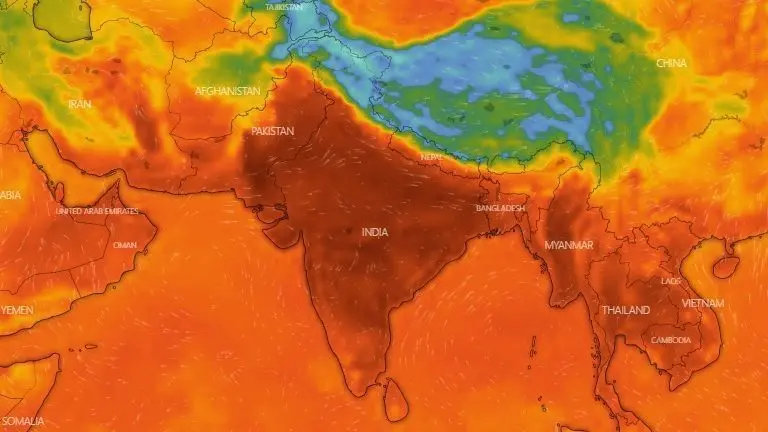
New Delhi: India is at the centre of an intense global heatwave, with 19 of the world’s 20 hottest cities recently located within the country, according to temperature data cited in several reports. Cities across Bihar, West Bengal, Odisha and Uttar Pradesh have recorded searing temperatures of up to 44°C, placing India firmly at the top of the global heat chart.
Among the hottest locations were Bhagalpur, Talcher and Asansol, each touching 44°C. Several other cities in eastern India hovered around 43°C, highlighting how widespread the heat has become.
Meteorologists say the scorching spell is being driven by a combination of factors. Strong pre-monsoon solar heating, cloudless skies over northern and central India, and dry northwesterly winds have created ideal conditions for rapid temperature rise. Reduced winter snow cover across Eurasia and the Himalayas has also played a role, as less snow means less sunlight is reflected away, increasing warming over the subcontinent.
Adding to the concern is the possibility of a strong or even “Super El Niño” developing later this year. Global forecasters say there is a high chance of El Niño conditions emerging in the second half of 2026, which could bring hotter and drier weather across much of Asia while disrupting rainfall patterns. For India, that may mean a weaker monsoon and longer heatwaves.
“After a period of neutral conditions at the start of the year, climate models are now strongly aligned, and there is high confidence in the onset of El Nino, followed by further intensification in the months that follow,” said Wilfran Moufouma Okia, Chief of Climate Prediction at WMO, according to ANI.
The India Meteorological Department already indicated that the 2026 southwest monsoon may be below normal, around 92% of the long-period average, reported HT.
Climate experts say the clustering of so many extreme temperatures in one country is a sign of rising climate volatility. With temperatures soaring earlier and more intensely each year, India’s battle against extreme heat may only be beginning.
The International Centre for Integrated Mountain Development, as claimed in an HT report, has said that snow cover in the Hindu Kush Himalaya was 27.8% below the long-term average, the lowest in records for four consecutive years.
This region supplies water to Ganga, Indus, and Brahmaputra. According to experts, lower snow means reduced river flow in summer, higher risk of drought in downstream regions.