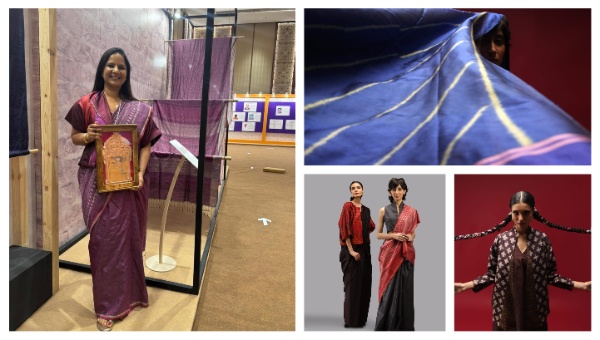
Bhubaneswar: Delhi-based designer Gunjan Jain has reimagined Odisha’s traditional bandha or ikat, infusing each thread with innovation and purpose. Her transformative contributions to this intricate craft were recognised on a national stage when she was conferred the National Handloom Award for Design and Development by Union Minister of Textiles Giriraj Singh.
Among her most striking innovations is the creation of ikat on fibre extracted from the bichchu booti or nettle plant—an indigenous species found in the Kumaon and Garhwal regions of Uttarakhand. For over a decade, Jain has collaborated closely with artisans in remote Odisha villages under her label ‘Vriksh’, breathing new life into the waning art of tapestry weaving and introducing contemporary dimensions to the traditional jala weaving technique.
As Jain recounts, she was captivated by the unwavering dedication of Odisha’s weavers, who have preserved the labor-intensive jala form even as much of the country has transitioned to the mechanised jacquard technique. Unlike jacquard—which uses punched cards to automate the weaving process—jala relies on a manual system of loops and knots to guide the warp threads. Jain believes jala offers greater artistic freedom, enabling artisans to explore varied patterns and motifs using the same setup. This very belief led her, a Jain by birth, to relocate to Bhubaneswar in 2007, leaving behind a lucrative career in the corporate apparel sector and high-profile brand associations in pursuit of a more meaningful, creative, and sustainable journey.
Her affinity for handlooms dates back to her childhood. “My mother was an art historian. I don’t recall her wearing anything but handloom. For years, we didn’t even know that anything beyond handloom clothing existed,” she shared.
Drawn by this early exposure, she moved to Odisha to immerse herself in its rich heritage of textile artistry. “At that time, there were barely any designers working directly with weavers in Odisha,” she noted. But her on-ground experiences revealed to her that the state is nothing short of a “goldmine” of artistic expression and cultural legacy.
“Each district here has its own distinctive art and cultural language,” she said. “In Jajpur, you witness an exquisite farm-to-fabric narrative in tussar production. A little farther lies a Buddhist village, its philosophies subtly influencing handloom aesthetics. Sambalpur and Bargarh speak in their own dialect of ikat. Then there’s the delicate embroidery of the Dongria Kondhs, and Kotpad from Koraput—the list is endless.” It is this treasure trove that she sought to bring to the world’s attention.
Odisha’s cultural and culinary richness didn’t just influence her professional direction—it transformed her lifestyle. “I turned non-vegetarian after falling in love with Odia cuisine. Fish is now a staple for me, even though I come from a vegetarian family,” she chuckled, adding, “The art in Odisha helped me rediscover myself—as both designer and artist.”
Though the pandemic necessitated a move back to Delhi, she remains deeply connected to Odisha’s soul, heritage, and artisan communities.
Know Her Brand: Vriksh
Named after the Sanskrit word for “tree,” Vriksh draws inspiration from nature’s resilience, abundance, and harmonious spirit. Founded in 2008, this design studio is headquartered in Delhi but has its creative heart firmly rooted in Odisha. Guided by a crafts-first philosophy, the label channels regional handloom and design traditions into a contemporary aesthetic. Each Vriksh creation—be it a saree, dupatta, or stitched ensemble—is handwoven in collaboration with artisanal clusters across Odisha.
“Mindful production, conscious living, and building sustainable livelihoods for craftspeople are the guiding values behind our work,” Jain explained.
Reviving Ganjam Bomkai, Dhalapathar Tapestry, and More…
Innovation in textile and craft forms the core of Vriksh’s design ethos. “When we started in Odisha, the region was largely identified with Sambalpuri ikat. Over time, we have expanded our practice to include lesser-known and nearly forgotten traditions,” she said.
This includes the Ganjam Bomkai, the Dhalapathar Tapestry, and the application of natural dyes in ikat. Jain has also introduced narrative textiles through Pattachitra hand-painting and reimagined traditional motifs to cater to contemporary global sensibilities.
“Our collections are a confluence of diverse inspirations,” she added, “from coastal trade histories between India and Southeast Asia to the mystic poetry of Kabir, and even the playful polka dots of Japanese artist Yayoi Kusama.”
Notably, many artisans associated with Vriksh have earned accolades, including state and national awards for excellence in handloom weaving.
Expanding Beyond Odisha and Garnering Global Recognition
A graduate in Fashion Design and Technology from Pearl Academy, Delhi, Jain has consistently championed artisan-centric innovation. Her work spans several states—Odisha, Jammu & Kashmir, Rajasthan, Himachal Pradesh, Uttarakhand, West Bengal, Andhra Pradesh, and Karnataka—across diverse textile and craft disciplines. These include ikat weaving, namda (wool craft), sozni and aari embroidery, kantha, banana fibre weaving, jute rug-making, dabu block printing, wool weaving, jamdani, and more.
In addition, she has showcased her textile work at exhibitions such as Sutr-Santati (2022) and Chitram Vastram (2023) at National Museum Delhi; Entwined (2024) curated by Sharan Apparao at Bikaner House, Delhi; Feeling Through Fibre (2024) at 47-A, Mumbai; and “Gamchha: The Extraordinary in the Ordinary” by Dastkari Haat Samiti (2025) at National Crafts Museum and Hastkala Academy, Delhi.
Gunjan has also represented India at the World Ikat Textile Symposium & Exhibition, with her label Vriksh’s natural dyed Ikat textiles, and showcased her textiles and designs in the US, UK, Singapore, Thailand, Indonesia, Uzbekistan, and Malaysdia, Phillipines. She was the recipient of Award for Excellence in Crafts 2024 by World Crafts Council; the UNESCO Award for Significant Innovations in Traditional Crafts 2022 in Uzbekistan; previously, in 2016, she won the Vogue India Fashion Fund in the saree category