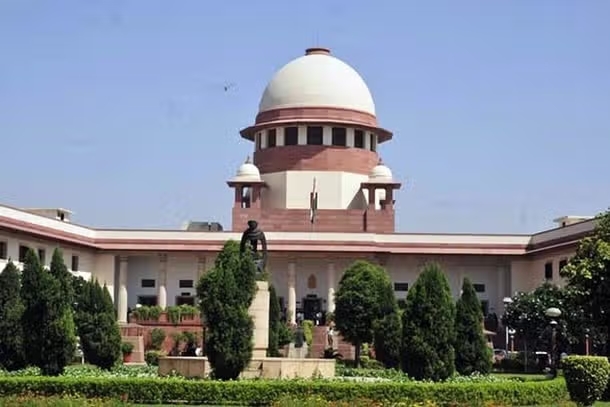
New Delhi: The Supreme Court on Monday sharply criticised its own January 5 verdict that denied bail to former JNU student leader Umar Khalid and activist Sharjeel Imam in the alleged larger conspiracy case linked to the 2020 Delhi riots, observing that “bail is the rule and jail is an exception” even in cases registered under the Unlawful Activities (Prevention) Act (UAPA).
A bench of Justices BV Nagarathna and Ujjal Bhuyan made the observations while granting bail to Jammu and Kashmir resident Syed Iftikhar Andrabi in a narco-terror case probed by the National Investigation Agency (NIA), reported live law. During the hearing, the court expressed “serious reservations” about the reasoning adopted in the January verdict delivered by another bench of Justices Aravind Kumar and NV Anjaria.
The top court underlined that the earlier judgment had failed to properly apply the principles laid down in the 2021 Union of India vs KA Najeeb ruling, where a larger bench held that prolonged incarceration and delays in trial could override the strict bail restrictions under Section 43D(5) of the UAPA. Reading out portions of the judgment in open court, Justice Bhuyan said, “Bail is not an empty statutory slogan. It is a constitutional principle flowing from Article 21.” The bench further observed that the presumption of innocence remains a cornerstone of the criminal justice system.
The court also stated that even under the UAPA framework, denial of bail must depend on the specific facts of each case and cannot become a blanket rule.
“A judgment rendered by a bench of lesser strength is bound by the law declared by the bench of greater strength. Judicial discipline mandates that such a binding precedent must either be followed or, in case of doubt, be referred to a larger bench. A smaller bench cannot dilute, circumvent or disregard the ratio of a larger bench,” Justice Ujjal Bhuyan said, as quoted by India Today. He was alluding to a two-judge bench that denied Khalid bail.
On January 5 this year, the Supreme Court had refused bail to Umar Khalid and Sharjeel Imam in the Delhi riots conspiracy case, while granting relief to five other co-accused, including Gulfisha Fatima, Meeran Haider and Shifa Ur Rehman. At the time, the court had held that Khalid and Imam stood on a “qualitatively different footing” due to the gravity of allegations against them.
Khalid later filed a review petition against the January ruling, but the Supreme Court dismissed it in April, declining his request for an open-court hearing.