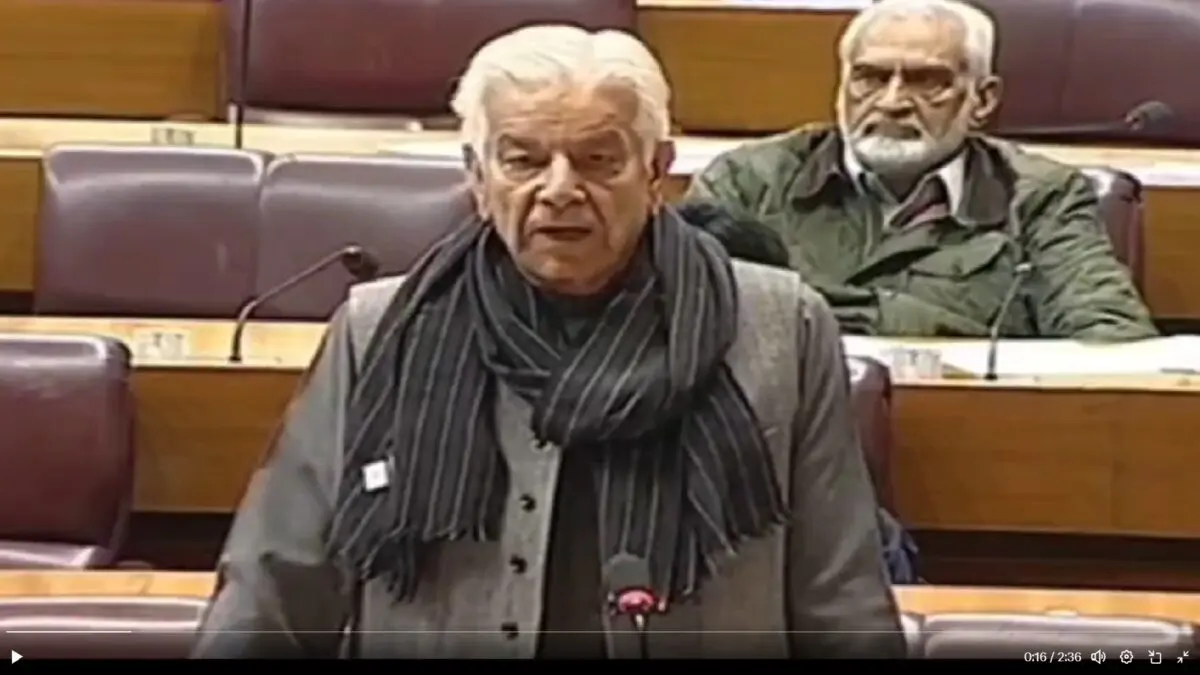
Islamabad: Pakistan’s Defence Minister Khawaja Asif delivered a strongly worded critique of Islamabad’s historical relationship with the United States during a session of the National Assembly on Wednesday, describing past alignment with Washington as a grave strategic miscalculation that inflicted long-lasting damage on his country.
Addressing lawmakers, Asif, according to a NDTV report, said Pakistan’s decision to realign with the US after 1999 — particularly in the wake of the September 11, 2001 attacks — had devastating consequences. Reflecting on decades of foreign policy choices, he said: that “Pakistan was treated worse than a piece of toilet paper and was used for a purpose and then thrown away.”
According to the minister, Islamabad’s involvement in two Afghan wars — first during the Soviet occupation in the 1980s and later in the US-led war on terror — harmed Pakistan’s internal security and social fabric. The Pakistani minister termed Islamabad’s involvement in the two Afghan wars “a mistake.” According to him, terrorism in Pakistan today was the blowback of past mistakes.
Big statement –
“Pak was used like toilet paper”Khawaja Asif admitted that Pakistan has historically fought wars for superpowers & waged a “Made in USA” jihad. Asif also claimed that Pakistan was treated “worse than toilet paper” by USA, used for a purpose and then discarded. pic.twitter.com/DpNFAWfG9I
— War & Gore (@Goreunit) February 11, 2026
He acknowledged that Pakistanis were mobilised and sent to fight under the banner of jihad, but called that narrative misleading and destructive, saying it was driven more by foreign geopolitical interests than by genuine religious motivation.
He said that while the United States eventually withdrew from the region, Pakistan was left grappling with prolonged violence, radicalisation and economic strain, the NDTV report states.
Asif also criticised the country’s former military rulers, including Zia-ul-Haq and Pervez Musharraf, for drawing Pakistan into external conflicts to secure American support rather than safeguarding national interests. “Two former military dictators (Zia-ul-Haq and Pervez Musharraf) had joined the war in Afghanistan, not for the sake of Islam, but to appease a superpower,” he said.
“We deny our history and do not accept our mistakes…” he added.
“The losses we suffered can never be compensated,” the defence minister said, describing those decisions as irreversible mistakes that reduced Pakistan to a pawn in conflicts driven by others. He also said Pakistan’s education system was reshaped to justify involvement in these wars, with ideological changes that remain embedded in society.
Asif’s remarks mark one of the most candid acknowledgements by a senior Pakistani official of the long-term costs associated with decades of alliance with the United States. These remarks can have implications for how Islamabad evaluates its foreign policy priorities going forward.