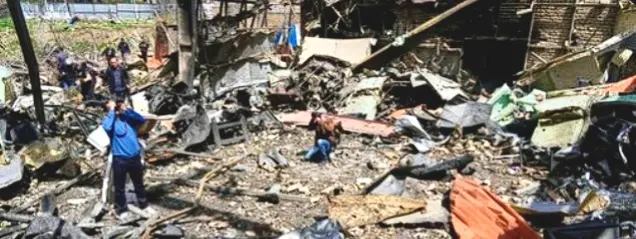
Tehran/Jerusalem/Dubai: Coordinated airstrikes by Israel and the United States on Monday killed more than 25 people across Iran, prompting Tehran to retaliate with missile barrages on Israel and Gulf Arab allies as US President Donald Trump’s deadline for reopening the Strait of Hormuz approached.
Overnight blasts shook Tehran, with jet engines roaring low over the capital during prolonged assaults. A strike near Azadi Square targeted Sharif University of Technology, sending thick black smoke skyward and damaging campus structures plus a nearby natural gas facility, according to Iranian state media. The site, vacant due to war-mandated online schooling nationwide, has long been sanctioned internationally for reportedly supporting Iran’s Revolutionary Guard-led ballistic missile efforts, agencies reported.
Israeli officials reported two fatalities in Haifa from collapsed residential ruins, with ongoing searches for two others amid fresh Iranian missile impacts on the northern city early on Monday.
Meanwhile, Kuwait and the United Arab Emirates scrambled air defenses to thwart incoming Iranian missiles and drones aim
ed at Gulf states. Tehran’s persistent strikes on energy assets and its chokehold on the Strait of Hormuz — a vital artery for one-fifth of global oil in normal times — have spiked Brent crude to $109 a barrel in early trading, a 50% surge from pre-war levels.
Iran has permitted selective shipping through the strait since hostilities erupted on February 28 — excluding US, Israeli, or allied vessels, with some paying fees — but traffic has plunged over 90% year-on-year.
Facing mounting US consumer anxiety over fuel costs, Trump set a Monday night (Washington time) cutoff for Iran to restore strait access, vowing attacks on power plants and key infrastructure to regress the nation “back to the stone ages.” His Easter Sunday social media post escalated: “Tuesday will be Power Plant Day, and Bridge Day, all wrapped up in one, in Iran,” warning that refusal would mean “you’ll be living in Hell.”
Iran’s Parliamentary speaker Mohammad Bagher Qalibaf rebuked the rhetoric on X: “You won’t gain anything through war crimes,” he wrote. “The only real solution is respecting the rights of the Iranian people and ending this dangerous game.”
Amid the brinkmanship, diplomacy persists. Oman’s Foreign Ministry announced Iran-Oman talks involving deputy ministers and experts on “smooth transit” proposals. Egypt’s Foreign Minister Badr Abdelatty engaged US envoy Steve Witkoff, Iranian counterpart Abbas Araghchi, and officials from Turkey and Pakistan. Araghchi also held discussions with Russian Foreign Minister Sergey Lavrov.