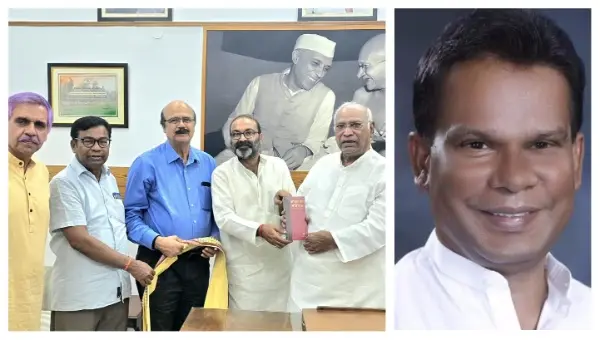
Bhubaneswar: Amid the newfound bonhomie between BJD and Congress, eminent urologist Dr Datteswar Hota, who has been fielded a “common candidate” by the regional party for one of the four vacant Rajya Sabha seats from Odisha, met Congress President Mallikarjun Kharge in New Delhi on Saturday.
Odisha Pradesh Congress Committee (PCC) President Bhakta Charan Das was also present during the meeting as Hota sought the support of 14 MLAs of the party in the state Legislative Assembly.
He is pitted against former MP and hotelier Dilip Ray, who is contesting as an Independent candidate with the backing of the ruling BJP, and this has intensified the threat of horse trading and cross-voting ahead of the Rajya Sabha elections scheduled for March 16.
Considering the strength of the parties in the 147-member Odisha Assembly post 2024 elections, the ruling BJP with 79 MLAs and the support of three Independents, can comfortably secure two of the four seats. After securing those, it would have 22 surplus votes, eight short of the threshold needed for a third seat on its own. The BJD, with 48 MLAs following the suspension of two legislators, has enough to win exactly one seat for party president Naveen Patnaik’s political secretary, Santrupt Misra. It would be left with 18 surplus votes and the Opposition expects that with the support of Congress and CPI(M) with 14 and 1 MLAs respectively, Hota can survive the electoral battle.
However, this is only a theoretical edge for the Opposition keen to thwart a BJP sweep in the polls.
While filing his nomination on March 5, Ray, who served in Union ministries under the NDA between 1996 and 2000, expressed confidence in securing “conscience votes”, a term often used to justi
fy cross-voting in Rajya Sabha polls.
The former MP seems to draw confidence from his earlier experience in 2002 when he was elected as an independent to the Upper House after more than a dozen MLAs cross-voted in his favour. “Had I not been confident, I would not have entered the fray,” he stated, while noting the short preparation time compared to 2002.
Ray is expected to capitalise on discontent within the Congress and the BJD, having invoked the legacy of “Biju Babu” under whom he began his political career to appeal to supporters across parties. He was also a founding member of the BJD before being expelled in 2002 for contesting for the Rajya Sabha berth against the party’s directive.
If suspended MLAs, Arabinda Mohapatra and Sanatan Mahakud, cast their votes for Ray, the former Union minister would need only six additional first-preference votes to secure victory, a margin that appears well within reach given the considerable resources and influence at his disposal. All eyes are also two more ‘disgruntled’ BJD MLAs – Cuttack-Choudwar MLA Souvic Biswal, whose father and former MLA Pravat Biswal was recently expelled for publicly criticising the party’s leadership and questioning the selection of candidates for the Rajya Sabha elections, and Banki MLA Debi Ranjan Tripathy, son of former MLA Pravat Tripathy.
A section of Congress leaders also seems dissatisfied with the current leadership, especially after the expulsion of former MLA Mohammad Muquim, whose daughter Sofia Alam is the sitting MLA from Cuttack-Barabati. Sofia and Sanakhemundi MLA Ramesh Chandra Jena had earlier skipped a key Congress Legislature Party (CLP) meeting to discuss election strategy and ensure unified support for Hota.
Apprehending the same, the BJD has accused the ruling party of encouraging horse-trading by backing Ray and asserting that he would win, despite lacking the required numbers.
However, the cross-voting can no longer be kept a secret. Unlike the secret ballot used in 2002, MLAs from political parties are now required to show their marked ballot papers to their party’s authorised agent before casting their vote.