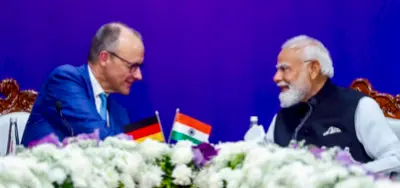
New Delhi: In a major move to ease travel, Germany announced visa-free transit for Indian nationals passing through its airports, on Monday.
Prime Minister Narendra Modi thanked German chancellor Friedrich Merz for the announcement, which will not only facilitate and ease travel of Indian nationals, but will further intensify people to people links.
The two countries finalised 19 agreements and announced a series of measures spanning defence, critical technologies, clean energy, education and mobility during the day. This happened during Merz’s two-day official visit to India.
The outcomes of these agreements were aimed at deepening cooperation across strategic, economic and people-to-people pillars of the bilateral partnership, the Ministry of External Affairs (MEA) said.
A ‘Joint Declaration of Intent’ to strengthen defence industrial cooperation was among the key outcomes, as reported by TOI.
“This will provide clear policy support to our companies for co-innovation and co-production in defence. New opportunities for cooperation will also open up in the space sector.” Prime Minister Modi said while addressing the India-Germany CEOs Forum.
The two sides decided to integrate a newly established CEO Forum into th
e joint India-Germany economic and investment committee framework to reinforce economic engagement.
India and Germany also signed declarations of intent covering semiconductor ecosystem development, cooperation on critical minerals, and collaboration in telecommunications, the MEA said.
An offtake agreement was signed between India’s AM Green and Germany’s Uniper Global Commodities for the supply of green ammonia. India’s Petroleum and Natural Gas Regulatory Board also signed an MoU with the German Technical and Scientific Association for Gas and Water Industries (DVGW) to cooperate on renewable energy.
The two sides adopted a higher education roadmap on education, skilling and mobility, and concluded additional agreements, including the setting up of a National Centre of Excellence for Skilling in Renewable Energy at the National Skill Training Institute in Hyderabad.
India and Germany agreed to establish a Track 1.5 foreign policy and security dialogue, along with a bilateral dialogue mechanism focused on the Indo-Pacific, the MEA said.
Germany committed an additional €1.24 billion under the green and sustainable development partnership for projects covering renewable energy, green hydrogen, the PM e-Bus Sewa programme and climate-resilient urban infrastructure. The Prime Minister’s Office said Germany had earlier committed €10 billion under the partnership for 2030, largely through concessional loans, with around €5 billion already utilised or earmarked since 2022.
A battery storage working group has been launched under the India-Germany Platform for Investments in Renewable Energy Worldwide, the MEA said.