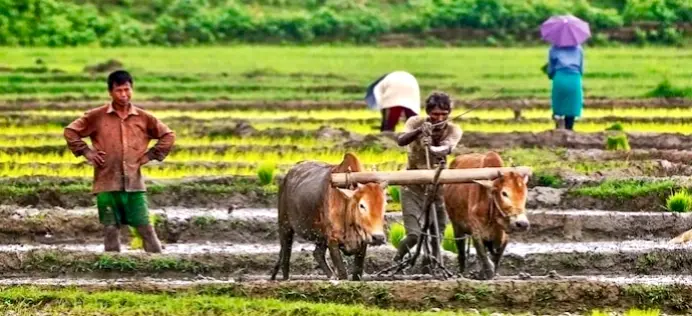
New Delhi: India has overtaken China as the world’s number one producer of rice and Odisha had an important role to play in this.
The United States Department of Agriculture (USDA), in its December 2025 report, has said that India’s rice production has reached 152 million tonnes, while China’s stands at 146 million tonnes. With this, India’s global share of rice production has crossed 28%.
This has not always been the case though. At the time of Independence, India produced only 20.58 million tonnes of rice annually, as reported by India Today.
India was struggling with a shortage of food grains in the 1960s. At the time, cultivation was limited to traditional long-stem rice varieties, with yields of only about 800 kg per hectare.
By then, urea had been introduced as a chemical fertiliser. While the use of fertiliser and additional water could increase output, this required dwarf and strong-stem varieties, which India did not have.
Indian varieties tended to lodge when fertiliser and water were used, as their long stems caused the crop to fall over. This led to the need for dwarf varieties to increase production and address food shortages.
That is when Taiwan stepped in to meet this requirement by providing its dwarf rice variety, Taichung Native-1 (TN1). This transformed Indian agriculture. TN1 played a key role in the Green Revolution and is considered the world’s first semi-dwarf rice variety.
Another dwarf rice variety, IR-8, w
as introduced in India in 1968 by the International Rice Research Institute. This triggered a rapid increase in production. Because of its revolutionary productivity, IR-8 came to be known as “Miracle Rice”.
In 1969, Indian scientists began cross-breeding these varieties.
In Odisha, a local rice variety called T-141 was cross-bred with TN1 to develop ‘Jaya’, India’s first domestically developed dwarf rice variety. Its stem length was reduced from 150 centimetres to 90 centimetres, leading to a sharp rise in production.
After this breakthrough, India did not look back in rice cultivation.
There are about 123,000 varieties of rice in the world, of which nearly 60,000 are found in India.
India exports rice to 172 countries. In 2024–25, India exported agricultural produce worth a record Rs 450,840 crore, with rice accounting for the largest share of about 24%.
By exporting basmati and non-basmati rice, India earned foreign exchange worth Rs 105,720 crore in a single year.
India still lags behind in one important area, despite becoming number one in rice production and exports. Though the area under rice cultivation in India is larger than China’s, per-hectare yields remain significantly lower.
According to the Union agriculture ministry, India produced only 668 kg of rice per hectare in 1950–51. This increased to 1,235 kg by 1975–76 after the introduction of dwarf varieties and increased fertiliser use. Yield rose to 1,901 kg per hectare in 2000–01 and further to 2,809 kg in 2021–22.
India’s average rice yield will reach 4,390 kg per hectare in 2025–26, the USDA estimates.
This remains below the global average though, and this is a matter of concern. Matching China’s yield of about 7,100 kg per hectare would mark a major milestone, particularly as rice cultivation requires large quantities of water.