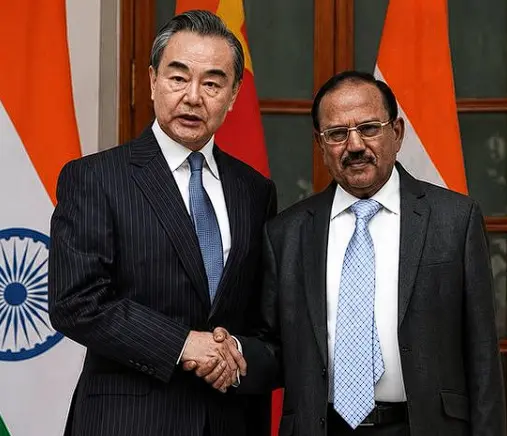
New Delhi: National Security Adviser Ajit Doval will travel to Beijing on Monday for the 25th round of talks between India and China’s Special Representatives on the boundary dispute.
Doval, India’s representative in the negotiations, will meet Chinese Foreign Minister and Politburo member Wang Yi on Tuesday. The two sides are expected to discuss the unresolved border question, measures to prevent fresh tensions and efforts to improve the broader relationship.
The meeting assumes added significance as India prepares to host the BRICS Summit in New Delhi on September 12 and 13. Chinese President Xi Jinping’s attendance has not been confirmed by either country, but officials remain hopeful that he will travel to India.
Possible Modi-Xi Meeting
Xi’s visit, if it takes place, could allow him to meet Prime Minister Narendra Modi, possibly around the time of his arrival for the summit. The two leaders last met in August last year on the sidelines of the Shanghai Cooperation Organisation summit in Tianjin.
A visit by Xi would be his first to India in seven years and would carry considerable diplomatic weight. The proposed engagement comes after relations deteriorated following the 2020 military confrontation in eastern Ladakh. Both countries have since taken steps to reduce tensions and revive wider diplomatic and economic engagement.
Doval and Wang are likely to assess the progress made in easing the situation along the Line of Actual Control and discuss further confidence-building measures. These efforts include improving connectivity, expanding people-to-people exchanges and restoring other channels of bilateral interaction, as reported by The New Indian Express.
The Special Representatives’ mechanism was set up in 2003 to explore a political framework for settling the dispute along the approximately 3,488-kilometre India-China border. Although 25 rounds of negotiations have not produced a final settlement, the mechanism remains an important platform for managing the dispute.
Border Peace A Priority
India has repeatedly stated that durable improvement in ties with China cannot be achieved without peace along the border. External Affairs Minister S Jaishankar made the point again on Saturday at the Economic Times World Leaders Forum in New Delhi.
“I think we went through a particularly bad patch between the summer of 2020 and the autumn of 2024, and that was primarily an outcome of the situation in the border areas,” Jaishankar said.
“At the end of the day, peace and tranquillity in the border areas is a prerequisite for good relations, and the state of the border, to a very large measure, naturally would determine the state of the relations,” he said.
His comments came amid reports of increased Chinese military activity in Arunachal Pradesh’s Upper Subansiri region in recent weeks.
Chinese Foreign Ministry spokesperson Guo Jiakun said on August 12 that the China-India border situation was “generally stable at the moment”.
Referring to the 36th meeting of the Working Mechanism for Consultation and Coordination on China-India Border Affairs, Guo said, “The two sides agreed to maintain communication via diplomatic and military channels and jointly uphold peace and tranquility in the border areas”.
Arunachal Dispute Continues
External Affairs Ministry spokesperson Randhir Jaiswal said on August 11 that India was treating the latest developments along the Line of Actual Control as “most serious”. He underlined that preserving peace and tranquillity along the LAC remained of “utmost importance”.
India has also rejected China’s protest over New Delhi’s decision to formally name 27 places in Arunachal Pradesh. While India describes the state as an “inalienable and integral” part of its territory, China refers to it as “South Tibet” and has, since 2017, issued its own names for locations there.
India has described the move as “vain and preposterous”, saying it cannot alter the “undeniable” reality that Arunachal Pradesh “was, is, and will” always remain an integral part of India.