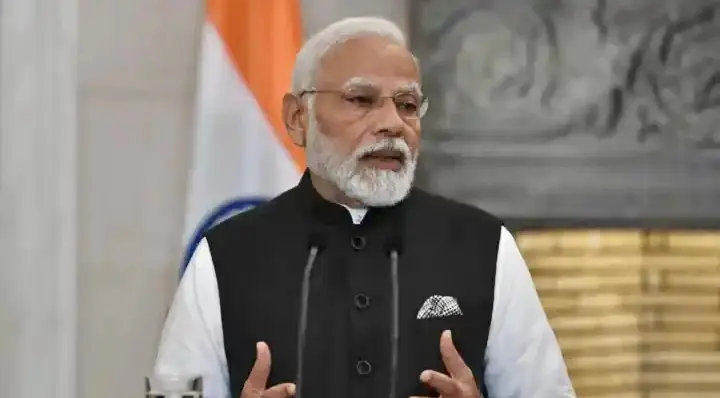
New Delhi: India had demonstrated “remarkable stability” during challenging global conditions, Prime Minister Narendra Modi has said, attributing it to a decade of macroeconomic stability and responsive policymaking.
The Prime Minister’s remarks follow chief economic advisor (CEA) V Anantha Nageswaran wrote that India had successfully navigated the economic fallout of the recent Gulf conflict, which temporarily disrupted shipping through the Strait of Hormuz, without facing a fuel crisis or macroeconomic instability, as reported by News18.
PM Modi shared Nageswaran’s opinion piece on X, and said: “India has shown remarkable stability during tough and testing times globally, despite our structural vulnerabilities. It has been achieved by ensuring macroeconomic stability over the last decade while making policy-making responsive and agile.”
“We are committed to furthering the process of Aatmanirbharta to safeguard our nation,” the Prime Minister said.
Nageswaran’s article was published by Business Standard. In it, he reflected on the country’s response to the conflict and wrote that despite fears of an oil shock, supply disruptions and a balance-of-payments crisis, India managed to maintain uni
nterrupted fuel supplies, stable domestic prices and overall macroeconomic stability.
“This was not an accident, and it was not luck alone. It was the work of a government that chose to act as it had during the pandemic-deliberately and gradually, building one measure upon another rather than reaching for a single dramatic lever,” he wrote.
“The first priority was the household. Throughout, not a single retail outlet ran out of stock, and every kitchen had its cylinder. The import-linked cost of a 14.2 kg cylinder rose above Rs 1,600, yet the household price was held near Rs 900, and lower still for the poorest,” the CEA added.
The government’s response included absorbing part of the fuel price shock through reductions in excise duty on petrol and diesel, maintaining cooking gas supplies, diversifying energy imports by increasing purchases from countries including the United States and Russia, and securing waivers to continue importing Russian crude, the CEA wrote.
In the article, Nageswaran also highlighted longer-term measures such as expanding piped gas connections, promoting ethanol blending, coal gasification and strengthening strategic crude storage.
“The government also pressed measures for the longer run: converting homes from cylinders to piped gas, a coal gasification programme, a further push on ethanol blending, and strategic crude storage agreed on the Prime Minister’s visit to the United Arab Emirates,” he wrote.
External accounts also remained stable, supported by policy measures to attract foreign investment, growth in exports and strong foreign direct investment inflows, Nageswaran wrote.
He acknowledged that easing global crude prices helped, but argued that prudent policymaking and timely government intervention played a key role in cushioning the economy from the impact of the Gulf conflict.