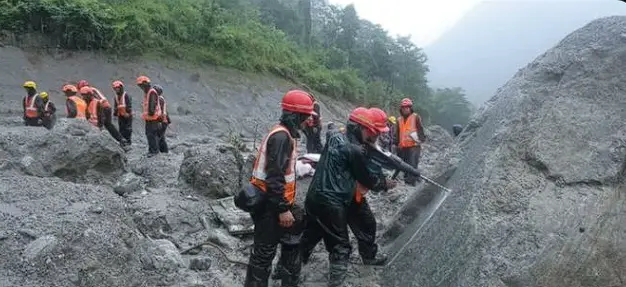
New Delhi: India has stepped up its emergency assistance to flood-hit Nepal, sending engineers, medical teams and forensic specialists to support rescue efforts in areas devastated by floods and landslides.
The Indian intervention comes as teams continue a difficult search for people feared trapped inside tunnels linked to hydropower projects. The operation has entered its fifth day, with rescuers facing blocked roads, submerged settlements and vast quantities of mud and debris.
Nepal’s disaster management authorities have put the death toll at 781 and said 2,502 people were still missing. In China’s Gyirong County, across the border, officials reported 16 deaths and 546 people unaccounted for.
Remains have been found in eight affected districts. Nepalese security personnel and specialist rescuers are clearing debris, examining flooded sites and trying to reach communities isolated by the disaster, as reported by The New Indian Express.
The Indian government said 149 of its citizens had been rescued as of 5.30 pm on Sunday.
New Delhi has so far sent 68.5 tonnes of relief supplies to Nepal and deployed teams with expertise in tunnel operations, emergency medicine and forensic identification. A fourth Indian aircraft carrying aid arrived in Nepal on Sunday with 11 tonnes of additional material.
The consignment included tunnel rescue equipment, forensic supplies for DNA testing and essential items for displaced residents.
The Ministry of External Affairs said the assistance included “blankets, sleeping bags, tarpaulin, plastic sheets and hygiene kits”.
An Indian team of 11 members, including doctors, paramedics and tunnel engineers, has begun assessing hydropower facilities in the Trishuli corridor of Nuwakot district.
The specialists first conducted an aerial survey of Chilime and Langtang before moving towards the affected tunnel sites. The reconnaissance was intended to help determine the safest approach for rescue machinery and personnel.
A major search operation is under way at the Upper Trishuli hydropower complex, where officials believe as many as 350 people may be trapped inside a tunnel.
An 82-member joint contingent of the Nepal Army, Armed Police Force and Nepal Police has been working at the site since Friday night. Its immediate task is to remove the debris sealing the tunnel and find out whether anyone remains alive inside.
Nepal’s armed forces transported heavy machinery to the remote location by air on Sunday. Rescue workers have reached one tunnel entrance and started clearing the blockage. Oxygen cylinders and cameras are also being readied for use once the passage has been made safe.
India’s forensic support is aimed at helping Nepal identify victims recovered from the disaster zone.
Indian Ambassador to Nepal Naveen Srivastava met the forensic specialists after their arrival. The team will coordinate with Nepalese agencies to conduct DNA tests on recovered remains and help establish the victims’ identities.
Around 10,000 Nepalese troops are engaged in rescue and relief work across the affected areas. Personnel from India and China are assisting with specialised operations.
The continuing search is focused on remote settlements and locations buried beneath flood debris. With thousands still missing, authorities are racing to open routes into cut-off areas and reach any survivors before prolonged confinement, lack of oxygen and worsening conditions make rescue impossible.