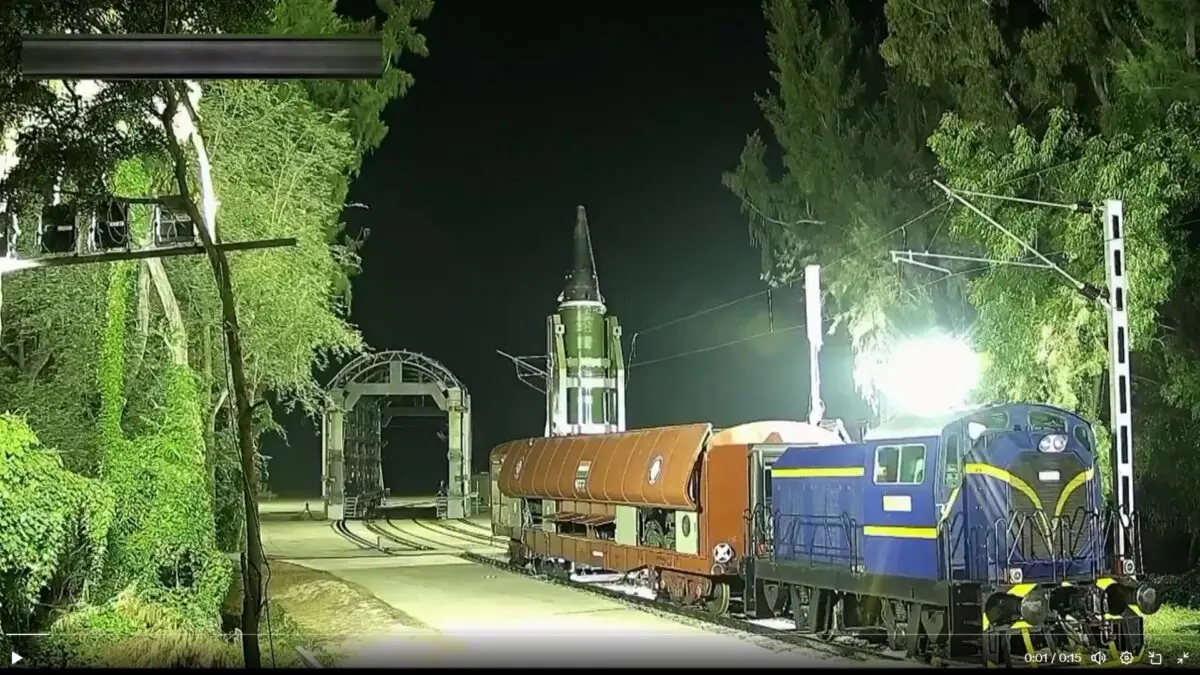
New Delhi: India has successfully launched its Agni Prime missile from a rail-based mobile launcher, marking a first-of-its-kind test in the country’s missile programme. The weapon, with a strike range of up to 2,000 km, was fired from a train pulled by an Indian Railways locomotive. With this launch, India joined an elite group of nations — Russia, the United States, and China — that possess the capability to fire railcar-based intercontinental ballistic missiles.
“This successful test has put India in a group of select nations that have developed canisterised-launch systems from on-the-move rail networks,” Defence Minister Rajnath Singh said. He described the achievement as groundbreaking, noting that “the first-of-its-kind launch was carried out from a specially-designed, rail-based mobile launcher … has the capability to move on the rail network without pre-conditions (and) that allows shorter reaction time and cross-country mobility.”
India has carried out the successful launch of Intermediate Range Agni-Prime Missile from a Rail based Mobile launcher system. This next generation missile is designed to cover a range up to 2000 km and is equipped with various advanced features.
The first-of-its-kind launch… pic.twitter.com/00GpGSNOeE
— Rajnath Singh (@rajnathsingh) September 25, 2025
The new system offers significant strategic advantages. Rail-based launches provide greater flexibility of deployment, allowing missiles to be moved to remote regions without the need for road access. They also enhance concealment and surprise, as missiles can remain hidden in tunnels or behind terrain until launch, making detection from satellites far more difficult. In addition, the widespread rail network allows decentralised storage, reducing the risks associated with fixed missile bases.
Experts, however, caution that there are trade-offs. Launches are limited to rail tracks, precision may not match fixed sites, and the rail network itself could be vulnerable to sabotage during conflict.
The concept is not entirely new. The Soviet Union in the 1980s deployed the RT-23 Molodets ICBMs from specially designed trains, while the United States experimented with its Peacekeeper Rail Garrison system before discontinuing it. Russia has also explored the Barguzin BZhRK rail-mobile ICBM system, though its development status remains unclear.
The Agni Prime rail launch demonstrates India’s intent to strengthen the mobility and resilience of its strategic deterrent. By leveraging its vast 70,000 km rail network, India gains a harder-to-detect, more survivable launch option. While the operational challenges of logistics, command, and security remain, the successful test underscores a bold step forward in India’s evolving missile capabilities.