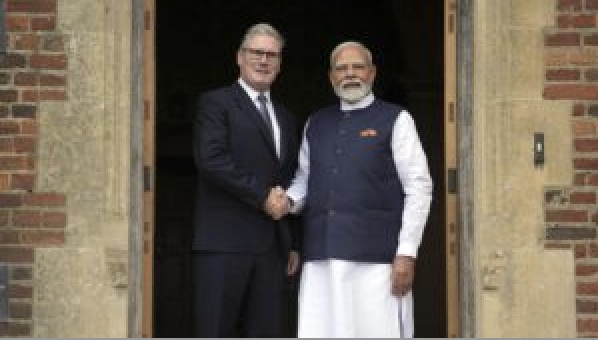
Chequers, United Kingdom: In a major diplomatic and economic breakthrough, India and the United Kingdom on Wednesday signed a landmark Free Trade Agreement (FTA), marking the most comprehensive bilateral trade pact since Brexit and the first of its kind between India and a European nation.
The deal was inked at Chequers, the UK Prime Minister’s country retreat, during Indian Prime Minister Narendra Modi’s official visit and meeting with British counterpart Keir Starmer. Both leaders hailed the agreement as a defining moment in bilateral relations that promises to bolster trade, investment, and strategic cooperation between the two nations.
This deal is anticipated to open up billions of dollars in trade and investment opportunities for both countries.
Key Features of the Agreement
The India-UK FTA promises sweeping tariff reductions and economic liberalisation:
- 99% of Indian exports to the UK — including textiles, footwear, pharmaceuticals, and food products — will now be tariff-free.
- India will gradually reduce duties on 90% of UK goods, with 85% becoming duty-free within 10 years, including aerospace parts, electrical equipment, cosmetics, and processed foods.
- Tariffs on Scotch whisky and gin, currently at 150%, will be halved immediately to 75%, and lowered further to 40% within a decade.
- Accompanying the trade pact is a Double Contributions Convention (DCC), allowing temporary workers from either country to be exempt from social security payments in the host country for up to three years — a move welcomed by Indian IT and healthcare professionals.
Leaders React
Calling the agreement a “historic milestone,” Prime Minister Modi said the pact would “strengthen our Comprehensive Strategic Partnership, drive economic growth, create employment, and promote innovation in both nations.”
Prime Minister Starmer described the agreement as a “landmark moment for Global Britain,” adding, “This is the most ambitious trade deal the UK has signed since leaving the European Union. It demonstrates our commitment to building strong relationships with major global economies.”
Economic Impact
Boost bilateral trade by £25.5 billion (~₹2.75 lakh crore) annually by 2040.
Increase UK GDP by an estimated £4.8 billion and UK household wages by £2.2 billion.
Create tens of thousands of new jobs and open doors for greater mobility of professionals, especially chefs, musicians, yoga instructors, and IT specialists.
Pending Ratification
Though the agreement has been signed, it will come into effect only after ratification by both the Indian and British parliaments. Implementation is expected by mid-2026.
Challenges Ahead
While the deal has been largely praised, some sectors — including UK farming unions and Indian SMEs — have raised concerns about domestic competition. Negotiations on certain sensitive sectors like agriculture and financial services were deferred and could be addressed in future amendments or supplementary protocols.
Strategic Significance
This deal marks a significant shift in India’s trade policy towards deeper global integration and aligns with the Modi government’s ‘Viksit Bharat 2047’ vision. For the UK, it underscores a pivot towards Indo-Pacific partnerships in the post-Brexit era.