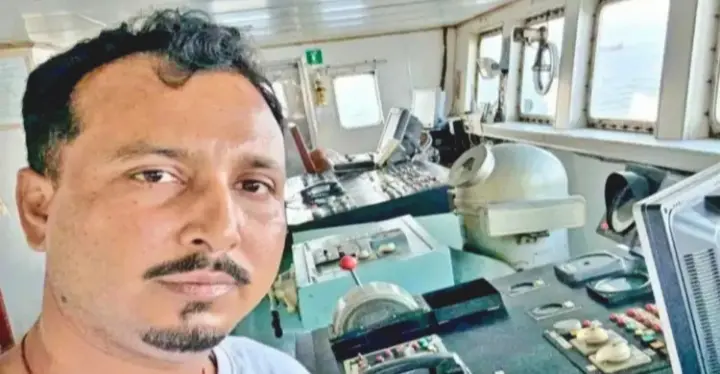
Mumbai: The two Indian seafarers killed in an attack on a tanker near the Oman coast on March 1, may not have had equipment to break through the portholes and escape, even as fire engulfed the vessel from both sides, India’s Directorate General (Shipping) has noted in a report.
Ashish Kumar, from Bihar, who was the captain of the tanker Sky Light and Dalip Singh, a crew member from Rajasthan, were killed in the attack during the ongoing conflict in the Gulf. The tanker was attacked near Oman’s Khasab port.
The DG (Shipping) has issued a safety advisory issued for Indian seafarers and shipping stakeholders operating in the Persian Gulf, Strait of Hormuz and nearby waters. It has noted that in a recent incident of a vessel coming under attack, crew members were trapped inside the accommodation area when fire engulfed it from both sides.
The only possible escape route was through the front portholes, but “there may not have been adequate provisions or equipment available to break the glass panels for emergency escape,” the advisory states, as reported by The Indian Express.
While Kumar was trapped in the master cabin, Singh was stuck in the accommodation area as flames spread across the vessel, leaving them with no clear escape route except through the front portholes, but there was no equipment available to break them open, sources told the newspaper.
Severely charred skeletal remains have been recovered from the captain’s cabin, which are believed to be Kumar’s, though DNA testing will be conducted to confirm the identity. Singh is still missing, presumed dead.
“We have re
covered remains from the captain’s cabin and arrangements are being made for the family to travel to Dubai for DNA testing to establish the identity,” an official said.
Merchant vessels operating in West Asian waters, have come under attack following the escalation of tensions between Israel and Iran.
Apart from Kumar, the death of another Indian seafarer has been confirmed. He was oiler Dixit Solanki from Mumbai, killed after a suspected missile hit the engine room of another crude oil tanker, MKD Vyom, operating off the coast of Oman.
A situation report issued by the DG (Shipping) at 1800 hrs on March 5, says at least 66 Indian-flagged vessels, were operating in the Persian Gulf region at that time. These included 24 to the west of the Strait of Hormuz and 12 to the east and in the Gulf of Oman. This places hundreds of Indian seafarers in waters that authorities have assessed as high-risk due to escalating hostilities in the region.
In its advisory, the DG Shipping has warned that recent attacks on merchant vessels in the Persian Gulf region and the Strait of Hormuz have involved drones, missiles and small craft carrying explosive payloads, highlighting the evolving nature of asymmetric maritime threats.
Indian seafarers operating in the Persian Gulf, Strait of Hormuz and nearby waters have been advised to maintain heightened vigilance and situational awareness. Masters and crew have been asked to ensure round-the-clock watch around vessels and to report any suspicious activity, including unidentified boats, drone activity or missile threats.
Shipping companies and recruitment and placement service licence (RPSL) agencies have also been asked to establish 24×7 emergency contact mechanisms so that seafarers and their families can receive timely information and assistance during crisis situations.
The DG (Shipping) has further recommended that companies consider providing psychological counselling support to seafarers and their families during distress situations.