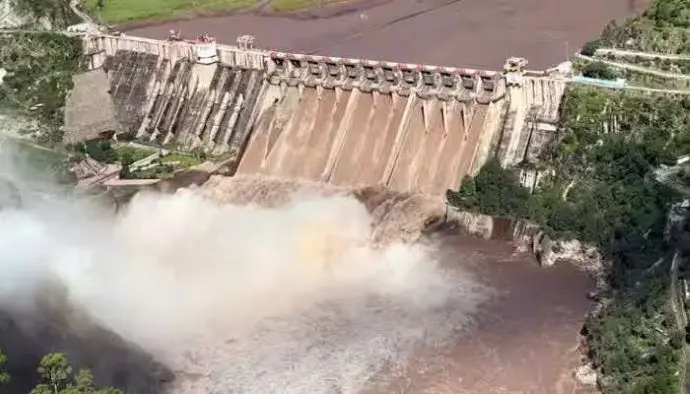
New Delhi: India rejected the International Court of Arbitration’s “supplemental award” on Kishenganga and Ratle hydroelectric projects in Jammu & Kashmir.
According to the Ministry of External Affairs (MEA), since the Indus Waters Treaty is in abeyance post the Pahalgam terror attack, India is not bound to perform any of its obligations under the Treaty.
“No Court of Arbitration, much less this illegally constituted arbitral body which has no existence in the eye of law, has the jurisdiction to examine the legality of India’s actions in exercise of its rights as a sovereign,” MEA said in a statement.
India has never formally recognised the existence of the “so-called Court of Arbitration”, and MEA emphasised that its creation under the Indus Waters Treaty was a “serious breach.”
Hence, any award or decision taken by the court is “illegal.”
The International Court of Arbitration, based in The Hague, Netherlands, directed India to submit operationa
l logbooks of the two hydroelectric plants by February 9, or provide an explanation for its refusal to do so.
Terming the move as the “latest charade at Pakistan’s behest”, MEA said it’s an attempt by Islamabad to escape accountability for its role as the global epicentre of terrorism.
“India has never recognised the existence in law of this so-called Court of Arbitration, and India’s position has all along been that the constitution of this so-called arbitral body is in itself a serious breach of the Indus Waters Treaty and consequently any proceedings before this forum and any award or decision taken by it are also for that reason illegal and per se void,” MEA said.
The Court of Arbitration said last week that India’s position of holding the treaty in abeyance “does not deprive the Court of Arbitration of competence”.
India is setting up Kishenganga project on Kishenganga river, a tributary of Jhelum, and Ratle project on Chenab river.
Pakistan had objected to India’s design features in 2015, and approached World Bank seeking a settlement. However, Pakistan withdrew its request in 2016, and sought adjudication through a Court of Arbitration instead.
India, on the other hand, sought a neutral expert to look into the differences. The World Bank appointed Michal Lino as the neutral expert on October 13, 2022, and also appointed a Court of Arbitration.