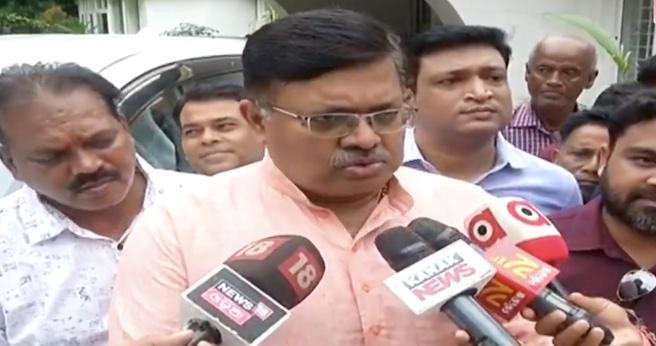
Bhubaneswar/Puri: The Archaeological Survey of India (ASI) has completed structural conservation of Ratna Bhandar, the treasury of Shree Jagannath Temple in Odisha’s Puri, and handed it over to the temple administration, Law Minister Prithiviraj Harichandan informed on Tuesday.
“The conservation work undertaken will ensure that the Ratna Bhandar is safe for the next 100 years. The inventory-related work is likely to begin in August. A final decision in this regard will be taken at a high-level meeting. A letter will also be sent to the RBI seeking two experts, who were earlier involved in inventory at Somnath Temple, as per the decision taken earlier,” he further stated, adding that new chests have been prepared to store the precious ornaments.
Inventory of the valuables was last carried out in 1978. The treasury has 128 kg of gold and over 200 kg of silver, temple sources said, adding that some of the ornaments with gold coatings were weighed at that time.
“The inventory of the valuables will include digital photography and cataloging with details such as their weight and make. Those will be then be tallied with the 1978 inventory, put back in the chests and sealed,” the minister added.
Harichanchan further stated that the government has kept its words to the people of the state. “The servitors have demanded for a new set of ornaments for the deities and accordingly a decision will be taken to provide gold for the purpose. The government will also urge devotees to donate gold for the purpose,” he said.
333 hours spanning 95 days
Earlier speaking to the media, Shree Jagannath Temple Administration (SJTA) chief administrator Arabinda Padhee had said: “The conservation work was carried out by the ASI for about 333 hours over a period of 95 days. As many as 80 people worked to conserve the Lord’s treasury.”
Ratna Bhandar, also known as the ‘Amuha Deula’, is located in the northern direction of the Srimandir. It was reopened on July 14, 2024, after a gap of 46 years. Thereafter, the valuables and jewellery were shifted from the inner Ratna Bhandar and outer Ratna Bhandar to temporary strongrooms. The ASI then conducted a laser scanning and penetrating survey. Following this, conservation and repair works commenced on December 17, 2024, and were carried out in two phases – from December 17, 2024, to April 28, 2025, and again from June 28, 2025, and till July 7, 2025.
“Now, as per the standard operating procedure approved by the government, the valuables will be transferred from the temporary strongrooms to the renovated Ratna Bhandar. Subsequently, inventory of the valuables will be conducted by experts selected by the government. The government has already appointed a high-level committee headed by Justice Biswanath Rath for the purpose,” Padhee added.
Structural conservation
The ASI has replaced 520 damaged stone blocks and a corbel arch in the inner and outer chambers of the Ratna Bhandar. “These are the major stone blocks from the exterior and interior side walls of both chambers of Ratna Bhandar, which had deteriorated over the years. Now, granite stones have been fitted on the floor,” ASI’s Superintending Archaeologist DB Garnayak told a presser.
Roof of the Ratna Bhandar has been sealed to prevent any water leakage and all cracks detected in laser scanning of the structure have been addressed. “This apart, 15 damaged beams in the structure have been replaced with stainless steel beams, both big and small. The renovation works have been done entirely in the traditional dry masonry method,” he added.