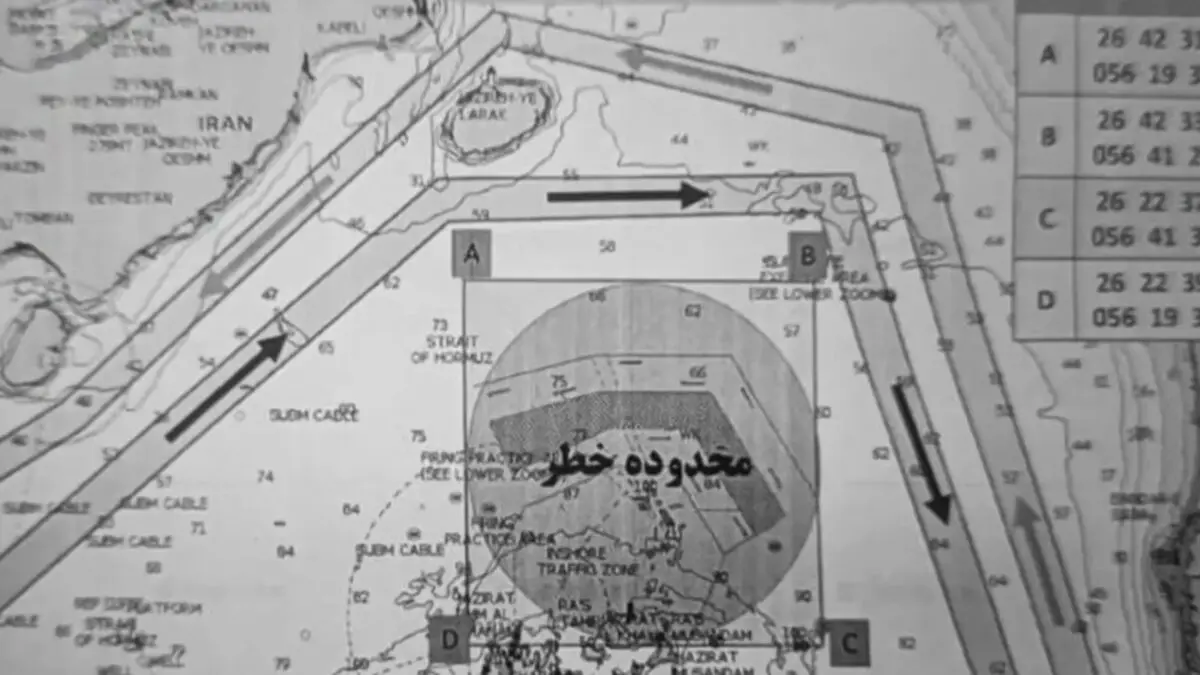
Tehran: Charts from Iran’s semi-official media on Thursday implied Revolutionary Guard mining of the Strait of Hormuz in wartime, an apparent attempt to sway the US as a fragile two-week ceasefire wobbles and Pakistan-brokered talks approach.
ISNA News Agency and IRGC-affiliated Tasnim shared maps circling a “danger zone” in Farsi atop the Traffic Separation Scheme — the chokepoint route for ships through the Persian Gulf strait, once ferrying 20% of traded oil and gas, while portraying alternate routes to avoid naval mines. Vessels shifted north toward Iran’s Larak Island in the midst of the conflict, according to observations.
Spanning February 28 to April 9, the charts offer no word on post-ceasefire demining.
Meanwhile, ceasefire doubts propelled oil prices higher on Thursday. While Brent crude gained 2.9% to $97.46 per barrel, US crude jumped 3.7% to $97.94 per barrel. Kpler tracking showed scant strait traffic on truce Day 1 (Wednesday) with only four AIS-enabled vessels passing through. However, “dark fleet” tankers with sanctioned Iranian oil probably transited unmonitored, AP reported.
US President Donald Trump reinforced resolve on Truth Social, stating his warship and troop buildup persists “until such time as the REAL AGREEMENT reached is fully complied with.” He warned, “If for any reason it is not, which is highly unlikely, then the ‘Shootin’ Starts,’ bigger, and better, and stronger than anyone has ever seen before.” Trump vowed Iran blocked from nuclear weapons and “the Strait of Hormu
z WILL BE OPEN & SAFE.”
The accord drew victory boasts from both camps and global relief, but attacks continued — drones, missiles on Iran and Gulf nations post-announcement. Israel unleashed fury on Lebanon’s Hezbollah on Wednesday, pounding Beirut’s commercial and residential districts; 254 fatalities marked the fighting’s highest toll in a single day, with rescuers probing rubble into the night. The violence threatened to scuttle what US Vice President JD Vance called a “fragile” deal.
Iran’s parliament Speaker Mohammad Bagher Qalibaf rejected upcoming dialogue as “unreasonable” over US infringement of three of Tehran’s 10 conditions: Israeli Hezbollah strikes, a post-truce drone into Iranian airspace, and refusal of enrichment concessions.
While Iran Foreign minister Abbas Araghchi maintained Lebanon war’s halt was part of the 10-point ceasefire initiative, Netanyahu and Trump demurred. Pakistan, which served as a mediator, said it applied to “everywhere including Lebanon and elsewhere.”
New York’s Soufan Center on Thursday warned that the ceasefire “hovers on the verge of collapse.” Its analysis read, “Even if Lebanon was formally outside the deal, the scale of Israel’s strikes was likely to be viewed as escalatory, nonetheless. Israel’s strikes can be understood both as an effort to drive a wedge between Iran and its proxies and as a response to being allegedly sidelined in the original ceasefire discussions.”
Meanwhile, the White House named Vance to spearhead US efforts in Islamabad on Saturday to end the war. Iran’s negotiation team arrives in the Pakistan capital late on Thursday, ambassador Reza Amiri Moghadam announced on X: “Iranian delegation arrives tonight in Islamabad for serious talks based on 10 points proposed by Iran,” amid “skepticism of Iranian public opinion due to repeated ceasefire violations by Israeli regime to sabotage the diplomatic initiative.”