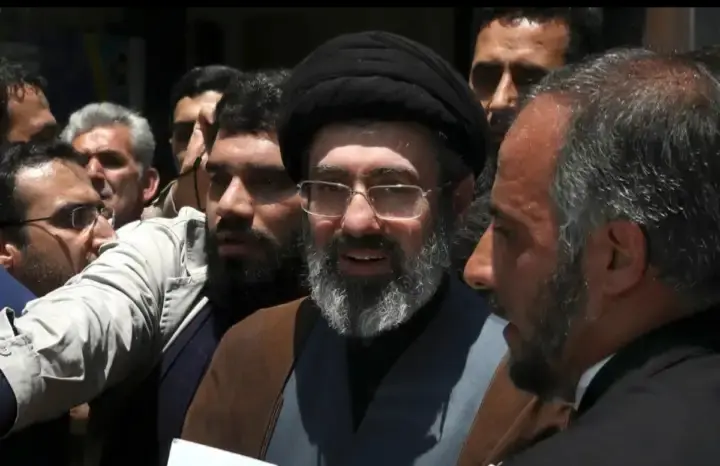
Tehran: Is Iran’s supreme leader Ayatollah Mojtaba Khamenei critical?
Reports suggest that he is facing renewed health concerns, with Iranian authorities drawing up a list of names of possible successors.
Mojtaba Khamenei’s health has remained under intense scrutiny since he succeeded his father, Ayatollah Ali Khamenei, who was killed on February 28 in US-Israeli strikes on Tehran.
His condition is “extremely critical”, Israeli outlet Channel 14 has reported, while other reports have suggested that his death could be imminent. However, these claims have not been independently verified, and there has been no confirmed official announcement regarding his condition, as reported by News18.
His absence from public view has fuelled speculation about his health and raised questions about what could happen if he were to die or become unable to perform his duties.
There is a procedure laid down in the Iranian Constitution to deal with a vacancy in the office of supreme leader. Under Article 111, if the supreme leader dies, resigns, is removed or becomes temporarily unable to perform his duties, a three-member Interim Leadership Council assumes his responsibilities until a new leader is appointed.
The council comprises the president of Iran, currently Masoud Pezeshkian, the head of the judiciary, currently Gholam-Hossein Mohseni-Ejei, and a religious jurist from the Guardian Council, selected through the process specified in Article 111.
If the position becomes vacant, the 88-member Assembly of Experts is constitutionally responsible for selecting the next supreme leader.
It is required to move as quickly as possible to appoint a replacement, because the supreme leader holds enormous authority over Iran’s military, judiciary, foreign policy and other key state institutions.
The names of several senior clerics and political figures have previously been discussed as potential candidates for Iran’s top leadership position, with Ayatollah Alireza Arafi being one of the top contenders.
He is a senior cleric, a member of the Guardian Council and a senior figure in Iran’s seminary establishment. He also served on the interim leadership council following Ali Khamenei’s death.
Ayatollah Hashem Hosseini Bushehri is another senior cleric with strong links to Iran’s religious establishment in Qom. He has held senior positions within the Assembly of Experts and the clerical establishment.
Another name doing the rounds is that of Gholam-Hossein Mohseni-Ejei, Iran’s judiciary chief. He has a long history in Iran’s judiciary and security apparatus and is regarded as a hardline figure.
The grandson of the Islamic Republic founder Ayatollah Ruhollah Khomeini, Hassan Khomeini, has also been mentioned in discussions over potential successors. His political positioning, however, differs from that of many hardline figures within Iran’s ruling establishment.
Iran’s constitutional framework also allows for the possibility of collective leadership under certain circumstances.
A leadership council could potentially emerge as an alternative arrangement if the Assembly of Experts is unable to settle on a single individual. Such a development would represent a major departure from the traditional model in which one supreme leader holds the country’s highest political and religious authority.
There are apprehensions that a sudden leadership vacuum could also strengthen the influence of the Islamic Revolutionary Guard Corps (IRGC), one of Iran’s most powerful military and political institutions.
The IRGC already has significant influence over Iran’s security apparatus, military operations and economy. In a period of uncertainty, it could play an increasingly important role in determining the country’s political direction and backing a successor acceptable to the security establishment.