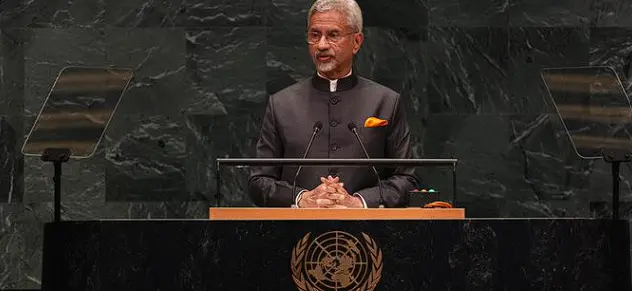
United Nations: External Affairs Minister S Jaishankar told the UN General Assembly on Saturday that the world is “living on the edge of an abyss” as it witnesses a “weaponisation of everything”.
Addressing the general debate of the Assembly’s 81st session in New York, he said finance, market access, supply chains and technology are being turned into instruments of leverage, leaving developing nations trapped in a deepening crisis.
‘Weaponisation Of Everything’
Jaishankar said that after eight decades of the UN, strengthening stability, security and predictability “should have become our second nature”.
Instead, he warned, “what we are actually seeing is a weaponisation of everything…” Resources and connectivity, he added, have become “particularly subject to leveraging”, pushing countries to de‑risk and diversify.
“While this may secure their interest to varying degrees, the overall atmosphere is no longer that of trust or goodwill,” he said.
Global South’s ‘4F’ Crisis
The minister described the Global South’s predicament as “particularly acute”, pointing to a “4F crisis” of food, fuel, fertiliser and finance, as reported by Hindustan Times.
“The combined impact of a super El Niño, compounding fertiliser shortages and now impediments to grain movements, all these are cause for alarm,” he said, noting that progress on the Sustainable Development Goals is under mounting pressure.
He also argued that “the Global South’s right to industrialise is also undermined by non-market practices and market denial”.
Terrorism & Pakistan
Without naming Pakistan, Jaishankar targeted what he called a “serial practitioner of terrorism” that had “misrepresented facts” before the Assembly a day earlier.
He said such arguments seek “to normalise terrorism and claim immunity from its consequences”.
“That will not stand. Our right to defend ourselves against terrorism will be exercised,” he said. “Friendship and goodwill cannot coexist with terrorism. And understandings premised on that will naturally be called into question. It is for the perpetrator of terrorism to mend its ways,” he added, calling state‑sponsored, cross‑border terrorism “a direct affront to the global order”.
Gulf, Ukraine & Seafarers
On the Gulf conflict, Jaishankar called the targeting of commercial shipping and seafarers in international waterways “simply unacceptable”.
He urged restraint, de‑escalation and protection of civilians, noting attacks have spread “from the Red Sea to the Black Sea”.
At least 15 Indian seafarers have been killed in West Asia and the Black Sea this year.
On Ukraine, he said: “As Prime Minister Narendra Modi stated, endless war must give way now to an end to war. India supports ongoing initiatives to bring peace. Even as this is underway, there is an urgent need to address the security of seafarers and supply of food grains and energy. India is prepared to do everything possible to ameliorate this situation, especially with regard to food and energy security.”
Reformed Multilateralism
Reiterating support for a two‑state solution in West Asia, Jaishankar said the post‑1945 order is giving way to new realities and “the case for reformed multilateralism only gets stronger day after day”. He closed by invoking Mahatma Gandhi: “There is no way to peace. Peace is the way.”