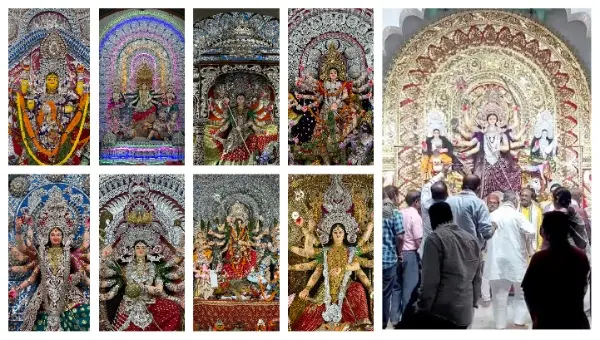
Kataka: As festive fervour grips the historic city of Kataka during the Durga Puja celebrations, the ‘Silver City’ has added a groundbreaking new chapter to its centuries-old devotional heritage. While Kataka’s iconic GI-tagged Tarakasi (silver filigree) Chandi Medhas, the intricate metallic backdrop tableaux, continue to dazzle millions, a standout innovation in brass has quietly carved a brand-new niche amidst the traditional sea of silver.
At Deula Sahi, the Netaji Nagar Durga Puja Committee introduced an 18-foot brass medha for Goddess Durga this year. Crafted using 192 kg of brass at an expenditure of Rs 10 lakh, this is the first committee in Cuttack to use brass as the primary metallic backdrop for the deity, offering a striking golden contrast to the city’s signature filigree tradition.
Durga Puja at Deula Sahi has been observed since 1942. It originally started with a 20-feet-high idol of Lord Hanuman before transitioning into the worship of Goddess Durga in strict accordance with Utkaliya culture and tradition.
A Festival of Grand Scale and Devotional Diversity
This year, festive grandeur reached new heights across Cuttack’s 176 puja pandals. While Goddess Durga is being worshiped at 105 pandals, traditional idols of other deities, including Hara-Parbatim are consecrated at the remaining locations. Notable transitions occurred this season as Shankarpur-Badambadi and Shree Shree Madan Mohan (Jhanjirimangala) committees transitioned from their long-worshipped Hara-Parbati idols to Goddess Durga. Meanwhile, Bakharabad maintained its historic tradition by worshiping an idol of Bharat Mata.
Out of the total pandals, 37 puja committees feature lavish silver tableaux, while around 15 incorporate gold ornaments, crowns, and weapons. Joining the elite silver tableau club this year is the Sahebzada Bazaar committee, which debuted its inaugural Chandi Medha crafted from 2 quintals of silver.
The Masterpieces of Cuttack’s Silver Circuit
Kataka’s Chandi Medha tradition dates back to 1956, when the Choudhury Bazar Durga Puja Committee pioneered the trend with a 2.5-quintal silver backdrop, later incorporating gold elements (Suna Medha). Today, each neighborhood brings its own distinct identity and artistic mastery to the festival:
College Square: Showcases a massive 350-kilogram silver medha that highlights the height of Odisha’s silver filigree craftsmanship.
Mahaveer Puja Mandap (Dargha Bazaar): Features 270 kg of pure silver valued at approximately Rs 4 crore, displaying fine, traditional Tarakasi wirework.
Khannagar Durga Mandap: Dazzles visitors with an impressive 400-kg silver backdrop complemented by a 3-kg solid gold crown.
Alisha Bazaar: Dating back to 1885, this historic mandap breaks away from Kataka’s typical flat backdrops by shaping its intricate filigree medha like a traditional temple structure, a design so famed it represented Odisha at the Pragati Maidan Pavilion in New Delhi in 2000.
Historic Highlights: The 500-year-old Balu Bazar Mandap preserves the city’s oldest devotional legacy, while Ranihat, Sheikh Bazaar, Chandni Chowk, Bidanasi, Professor Pada-Sagadia Sahi, and Chauliaganj continue to keep the city’s timeless traditions alive.
Unique Offerings and Sacred Traditions
Beyond the visual grandeur, Kataka’s mandaps are renowned for their distinct ritualistic offerings (bhoga). While most pandals distribute traditional khiri, suji halwa, khai, batasha, and seasonal fruits, select committees preserve rare culinary rituals:
Alisha Bazaar & Chandni Chowk: Maintain the unique practice of offering Machha Bhoga (fish offering) to Maa Durga on Nabami before distributing it among devotees.
Chauliaganj: Continues the beloved tradition of offering and distributing Dahi Pakhala (fermented curd rice) to visitors.
The Unsung Heroes of Tarakasi
Behind every sparkling silver strand are the generations of Tarakasi artisans working in the narrow alleyways of Kataka. Crafting thin silver wires into elaborate motifs over several months, these master craftspeople preserve an irreplaceable art form.
In a unique cycle of sustainability and heritage, the silver is carefully dismantled following the idol immersion and stored safely. Year after year, artisans reshape the existing metal into completely new designs—ensuring that the very same silver that mesmerised previous generations continues to tell fresh stories for the next.
Visual Spectacles and Safety Measures
To welcome pandal hoppers, committees erected thematic arches and light displays. A light gate replicating Taiwan’s Buddha Temple has been built at College Square, while Haripur-Dolamundai features Rajasthan’s Maya Mahal made of flowers and lights, Nuapada has erected a Prayagraj Mahakumbha Mela-themed gate, Khannagar has replicateed Varanasi’s Swarved Mahamandir Dham, and Malgodown has recreated a Grand Rajasthan Palace.
To manage the massive surge in footfall, the Commissionerate Police have deployed nearly 90 platoons in Kataka and 50 in Bhubaneswar. Traffic restrictions have been put in place alongside strict mandates for fire, electrical, and structural safety compliance. “Durga Puja is celebrated on a grand scale in Bhubaneswar and Kataka, with people generally following regulations. The police have urged all pandal organisers to prioritise safety, ensure electrical, fire and structural safety compliance, and obtain the necessary certificates. Any violations will invite legal action. Traffic will remain regulated and slower during the festivities, with an advisory already issued. Adequate police personnel will be deployed, including around 90 platoons in Kataka and approximately 50 in Bhubaneswar, to ensure public safety during the celebration,” Commissioner of Police, Bhubaneswar-Cuttack, Suresh Dev Datta Singh told the media.