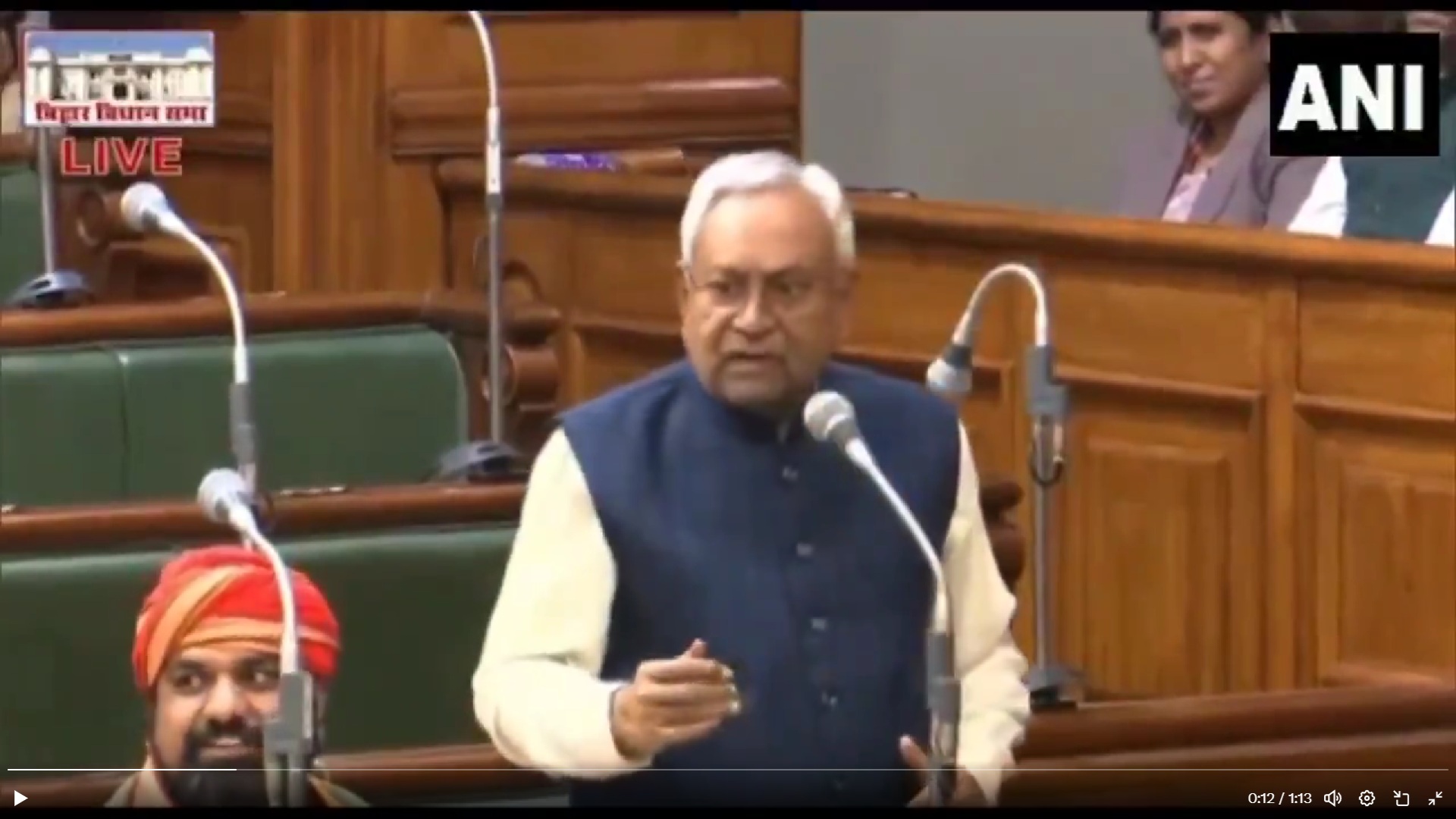
Bhubaneswar: Nitish Kumar’s political career is as much defined by his shifting alliances as by his longevity. Over more than four decades in Bihar politics, he has repeatedly changed camp — earning him the nickname ‘Paltu Ram’ and a reputation for strategic flexibility, but also charges of opportunism. At a time when he is likely to be Bihar’s CM for the tenth time after NDA-JD(U) alliance recorded a landslide victory, here’s how Kumar had jumped ships in his political career spanning over 40 years.
A Political chameleon: Nitish’s Many Ship-Jumps
- Breaking Away (1994):
Nitish began his journey within the Janata Dal under Lalu Prasad Yadav’s shadow. In 1990, Nitish Kumar had played a key role in making Lalu Yadav the Chief Minister. In 1994, refusing to remain in Yadav’s orbit, he parted ways and co-founded the Samata Party with George Fernandes.

- Aligning with BJP (1996):
Just two years after forming his own party, Nitish allied the Samata Party with the BJP. This foray into the NDA coalition brought him into national prominence through Lok Sabha seats. He served as a Cabinet Minister at the Centre under the NDA government. He handled the Railways (1998-1999, 2001-2004), Surface Transport (1998-1999), and Agriculture (1999-2000). In 1999, he had resigned as Railway minister after the Gaisal train disaster. In 2000, he was sworn in as Bihar chief minister. But his maiden term lasted only seven days as he resigned due to the lack of numbers.
Watch what Nitish had said while resigning as Railway Minister here:
On August 3, 1999, then India’s Railway Minister Nitish Kumar resigned following a fatal train collision citing inadequate investment in train upgrades and safety.#TrainAccident #WestBengalpic.twitter.com/yxQEgOpJvd https://t.co/x53l5OaorM
— Gems (@gemsofbabus_) June 17, 2024
- Uniting into JD(U) (2003):
In a consolidation move, his Samata Party merged with factions of Janata Dal and Lok Shakti to form the Janata Dal (United). Despite this structural change, his alliance with the BJP endured. The JD(U)-BJP coalition defeated RJD in 2005 and he became the Bihar CM for the first time. In 2010 also, JD(U)-BJP coalition had recorded landslide victory.
- First Real Break with BJP (2013):
After nearly 17 years in alliance with the BJP, Nitish abruptly broke off in 2013 — a turning point that marked his unwillingness to back Narendra Modi as the BJP’s Prime Ministerial face.
In 2014, following JD(U)’s poor performance in the Lok Sabha polls, he took moral responsibility and resigned as Chief Minister.
- The Mahagathbandhan Era (2015):
Nitish then stitched together a “Grand Alliance” (Mahagathbandhan) with RJD and Congress. This coalition won the 2015 Bihar Assembly election, and he became CM yet again.
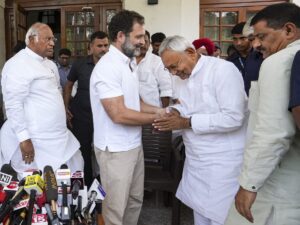

- Return to NDA (2017):
But history repeated itself: in 2017, citing corruption allegations against the RJD, Nitish ended his Mahagathbandhan government and rejoined the BJP-led NDA, becoming Chief Minister once more.
- Another U-Turn (2022):
In August 2022, he resigned from the NDA yet again, blaming the BJP for internal destabilization, and revived the alliance with the RJD and Congress.
- Back to the NDA (2024):
Less than two years later, in January 2024, he ended his ties with the Grand Alliance and rejoined the NDA.
Beyond the Flip-Flops: Nitish’s Political Journey
Early Years and Rise: Nitish cut his teeth as a socialist leader and was part of the Jayaprakash Narayan movement in the 1970s.
National Politics: He entered the Lok Sabha in 1989, and in 1990 was appointed as Union Minister of State for Agriculture and Cooperation in V.P. Singh’s government.
Chief Minister Entry: His first stint as Bihar CM came in 2000 — though it lasted only a week.
Established Rule: From 2005 onward, in alliance with the BJP, Nitish completed a full term and built a reputation as a governance-focused leader.
Electoral Resilience: Despite frequent alliance changes, he has frequently returned to power — sworn in multiple times as Chief Minister, thanks to his political acumen.
‘Paltu ram’ or a strategist?
Nitish Kumar’s repeated realignments raise questions: Is he a pragmatic strategist, adapting to changing political winds to stay relevant? Or is he an opportunist, willing to jettison allies whenever power dynamics shift?
Whatever the interpretation, his ability to navigate Bihar’s fractious politics — switching sides, re-forming alliances, and returning to power — has made him one of the most enduring and talked-about political figures in the state.