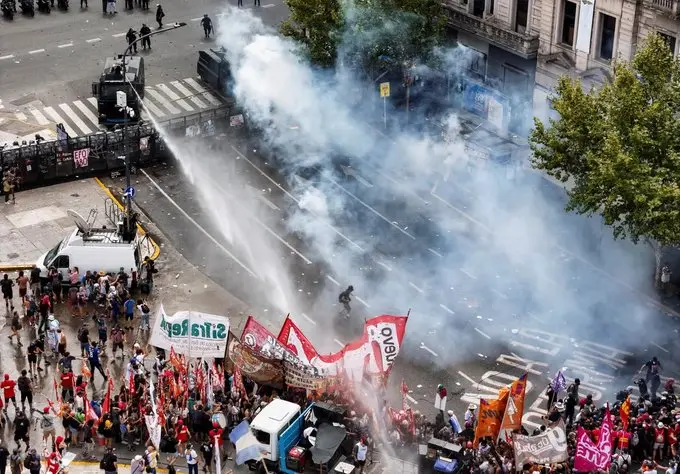
Buenos Aires, Argentina: Thousands of workers, union members and opposition supporters took to the streets of central Buenos Aires on Wednesday, in mass protests against a controversial labour reform bill proposed by President Javier Milei’s government. The demonstrations outside the National Congress building turned violent at times, with rocks, water bottles and Molotov cocktails thrown at security forces, reported AP.
Clashes erupted amid the legislative debate inside the Senate, which approved the labour reform in a 42-30 vote after intense discussion. The bill has now been sent to the lower house of Argentina’s Congress for further consideration.
Violence Erupts Outside Congress
As lawmakers debated the measure, dozens of demonstrators confronted police and security personnel near the Congress building. Some protesters hurled stones and makeshift incendiary devices at riot police, who responded with water cannon, rubber bullets and tear gas in an attempt to disperse the crowds. The clashes blocked traffic and created chaotic scenes in the capital’s key government district.
Security forces also faced Molotov cocktails thrown by segments of the crowd, and
police used crowd-control measures to contain the unrest.
Why the Unrest?
The labour reform bill championed by President Milei seeks to overhaul Argentina’s existing labour regulations, which his government and supporters argue are overly rigid and discourage formal employment. Proponents say loosening constraints on hiring and firing and reforming collective bargaining practices will attract investment and boost job creation.
However, powerful labour unions and opposition groups view the reforms as a rollback of hard-won worker protections. In a statement, the General Confederation of Labour–as reported by Al Jazeera, a trade union coalition that helped organise the demonstration, denounced the reforms as an attack on worker rights. “It’s not modernisation. It’s austerity for the workers,” the confederation said.
Critics say the changes would make it easier for businesses to fire employees, cut severance pay, restrict the right to strike, and diminish union influence in collective bargaining — eroding legal safeguards that have long been central to Argentina’s labour rights framework.
The General Confederation of Labour (CGT) and other union leaders condemned the reforms as a direct attack on workers, with union spokespeople calling them “austerity for the workers” rather than modernisation.
The protests reflect deep and historic tensions in Argentina over labour rights and economic reform. Labour unions have been a potent force in Argentine politics for decades, with roots in the country’s Peronist tradition.