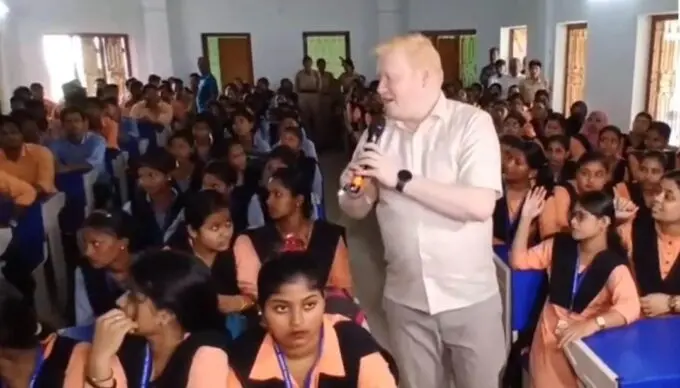
Jagatsinghpur: In an inspiring initiative aimed at bridging the gap between administration and the younger generation, Jagatsinghpur District Collector J. Sonal recently stepped into the role of an educator during a surprise visit to Balikuda College.
Accompanied by Sub-Collector Prasanta Kumar Tarai, the IAS officer, who has been actively inspecting educational institutions and government facilities since assuming charge to enhance public services and curb irregularities, arrived unannounced and took up a marker and duster to engage directly with Gen Z and Gen Alpha students in the classroom.
The session went beyond conventional textbooks, focusing on India’s intellectual heritage, ethical teachings, and local cultural roots. Drawing from the principles of ancient philosopher Chanakya and Kautilya, Sonal encouraged the students to apply strategic and moral insights to contemporary challenges. He highlighted the history and evolution of Lord Jagannath worship, traditions linked to the Prachi river, local temples, the spiritual heritage of Jagatsinghpur district, and the contributions of regional intellectuals and freedom fighters.
The Collector posed thought-provoking questions to test students’ critical thinking while answering their queries on governance, history, and personal growth.
Emphasising that true education extends far beyond books, he urged the youth to remain connected to their native soil, history, and spiritual traditions. “Today, I got the privilege and opportunity to spend time with the students at Balikuda College. My goal was to share thoughts regarding our youth and society—specifically, how we can connect Indian culture, history, philosophy, spirituality, and scriptures with Gen Z and Gen Alpha,” Sonal told reporters.
He further emphasised the need to inspire young minds about India’s intellectual legacy. “In today’s contemporary era, my attempt was to plant a seed—an inception—in the fertile minds of our youth about our intellectual history and rich heritage. When I interact with young people, listen to their thoughts, and answer their questions, it recharges me personally.”
Expressing satisfaction over the students’ awareness of ancient Indian scholars, he added: “When I asked the students a few questions during our interaction, they immediately recognised historical figures like Brahmagupta and Varahamihira. It made me immensely happy to see that our students at least know these foundational figures. Diving deeper into their contributions comes next, but knowing our roots is an important first step.”
He added that in the contemporary era, his attempt was “to plant a seed—an inception—in the fertile minds of our youth about our intellectual history and rich heritage. When I interact with young people, listen to their thoughts, and answer their questions, it recharges me personally.”
Students responded with enthusiasm to the informal teaching style. Om, a first-year BSc Zoology student, said, “It was our first time meeting the District Collector in person. He shared insightful knowledge about iconic Indian personalities and their contributions to science and philosophy, encouraging us to think independently and pursue deeper research.”