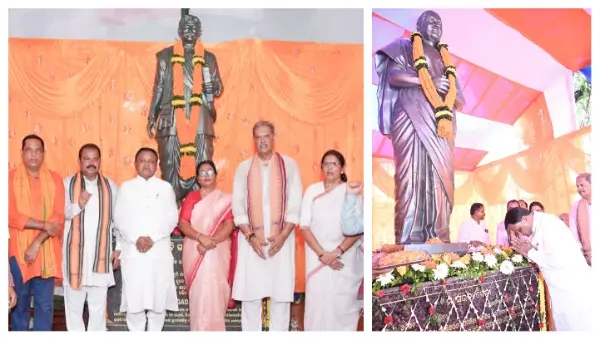
Bhubaneswar: In a day marked by historic remembrance and patriotic fervour, Chief Minister Mohan Majhi on Sunday paid tribute to the Odisha’s cultural and freedom struggle icons during the launch of ‘Har Ghar Tiranga’ campaign.
Speaking to reporters on the birth anniversary of Swabhava Kabi Gangadhar Meher, Majhi highlighted the poet’s enduring legacy in Odia literature. “Despite limited opportunities and challenging circumstances, Meher enriched Odia literature through unique masterworks like Tapaswini, Pranaya Ballari, and Indumati. His nature-inspired and humanistic writings continue to resonate deeply with every Odia heart and serve as a guiding inspiration for present and future generations,” he said.
The occasion was also marked by the unveiling of a life-size statue of pioneering freedom fighter and legislator Sarala Devi outside the Odisha Legislative Assembly, honouring the pivotal role of women in the freedom movement and public life. “Sarala Devi was not merely a leader or Odisha’s first female legislator; her contributions to the freedom movement and women’s rights were peerless. In the legislative assembly, she championed girl child education, widow remarriage, and social security for women. Her spirit of sacrifice and public service will forever inspire us,” the CM noted.
Born on 9 August 1904 at Narilo village near Balikuda in present-day Jagatsinghpur district, and married at age 14 to social worker Bhagirathi Mohapatra, Sarala Devi overcame formal educational barriers, having studied up to Class VII, to become a multi-talented writer, educationist, and political ethicist.
Close to national leaders including Mahatma Gandhi, Jawaharlal Nehru and Sarojini Naidu, she actively participated in the Non-Cooperation Movement in 1921 and the Salt Satyagraha in 1930, becoming one of the state’s earliest female political prisoners. Besides being the first Odia woman to join the Non-Cooperation Movement in 1921, she was the first woman elected to the Odisha Legislative Assembly and briefly served as its first female Speaker. As a legislator, she paved the way for women’s empowerment in Odisha by introducing progressive measures such as the Child Marriage Restraint Act (Odisha Amendment) and the Dowry Abolition Bill in 1936.
A prolific writer of some 30 books and hundreds of essays, she combined literary talent with feminist thought, social reform and education advocacy, leaving a legacy that continues to inspire generations. She tackled taboo subjects of her era, asserting women’s bodily autonomy, native language education, and anti-colonial economic models. They include Kuntala Kumari Kabi Pratibha (The Poetic Talent of Kuntala Kumari), Sarala Mahabharatare Nari Charitra (Women characters in Sarala Mahabharata), Beera Ramani (Women of Valour) Biswa Biplabini (Women Revolutionaries of the World), Narira Dabi (The Rights of Women), Rabindra Puja (Homage to Rabindranath), Nari Jagata (The World of Women) and Odia Bohu (The World of Odia Daughter-in-Law).
Her intellectual legacy, recognised by modern post-colonial feminist scholars, earned her the title “Iron Woman of Jagatsinghpur” in 1981 before her passing in 1986.