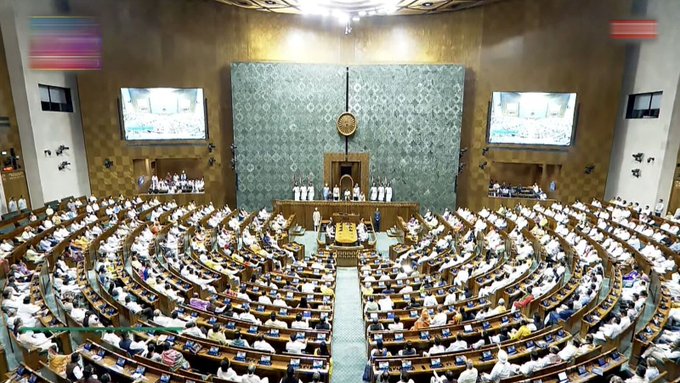
New Delhi/Bhubaneswar: In a significant move ahead of the special session of Parliament, the Union Cabinet Friday approved a proposal to increase Lok Sabha seats by 50 per cent across all states, potentially raising Odisha’s representation in the Lower House from the existing 21 to around 31-32 seats.
The proposal, cleared at a Cabinet meeting chaired by Prime Minister Narendra Modi, is aimed at expanding parliamentary representation while maintaining the existing proportion of seats held by individual states. The revised strength is proposed to remain in place until 2051, reported HT.
The decision assumes significance as the Centre prepares to revive its legislative push to implement 33 per cent reservation for women in the Lok Sabha and state Legislative Assemblies through a delimitation exercise.
Under the proposed formula, every state would receive a proportionate increase of 50 per cent in its Lok Sabha representation. This is intended to address concerns that states, particularly in southern India, could lose their relative political influence if seats were redistributed solely on the basis of population growth.
Odisha, which currently sends 21 MPs to the Lok Sabha, could see its representation increase to approximately 31 or 32 members. The additional seats would give the state a larger presence in national legislative proceedings and potentially strengthen its voice in debates on central funding, infrastructure, natural resources and regional development.
However, the projected figure is indicative and the final allocation will depend on the legislative framework and delimitation process.
The proposed expansion comes against the backdrop of a contentious debate over delimitation and the implementation of women’s reservation. Southern states have expressed apprehensions that population-based redistribution could penalise them for successfully controlling population growth, while increasing the political weight of states with higher population growth.
By proposing a uniform 50 per cent increase while retaining the existing inter-state proportion of representation, the Centre is seeking to address these concerns and build political consensus.
The Cabinet’s latest decision also follows the defeat of the Constitution (131st Amendment) Bill, 2026, in the Lok Sabha in April. The earlier legislative package sought to expand the strength of the Lower House and link the implementation of women’s reservation to delimitation. However, it failed to secure the constitutionally mandated two-thirds majority.
The government is now expected to bring a revised legislative package during the special sitting of Parliament beginning November 30. The Lok Sabha is scheduled to meet from November 30, while the Rajya Sabha will convene from December 2.
The proposed changes are closely linked to the implementation of the Nari Shakti Vandan Adhiniyam, which provides for 33 per cent reservation for women in the Lok Sabha and state Legislative Assemblies.
If the expansion and reservation proposals receive parliamentary approval, the enlarged Lok Sabha could create more opportunities for women’s political representation while increasing the overall number of elected representatives.
For Odisha, the proposed expansion could have implications beyond the numerical increase. A larger parliamentary delegation could provide greater representation to the state’s diverse geographical and socio-economic interests, including tribal regions, coastal districts, mining belts and underserved areas.
Nevertheless, the proposal will need to clear the parliamentary process before any increase in seats becomes effective. The final constituency boundaries and distribution will be determined through the prescribed delimitation mechanism.