Thiruvananthapuram: Judges of the Supreme Court and High Courts and senior lawyers expressed their views at a two-day legal conference, aimed at addressing the growing challenges of human-wildlife conflict that kicked-off in Kerala on Saturday. The conference is being organised by the National Legal Services Authority (NALSA) and Kerala State Legal Services Authority (KeLSA).
Speaking at the event, Supreme Court Justice M M Sundresh said that the conflict is one caused by human beings in their pursuit of boundless development. Using a WhatsApp message that he received to frame the issue, he noted: “If animals could have a religion, man would be the devil.”
Supreme Court Justice B V Nagarathna highlighted the situational awareness of animals using an incident from Mangalore reported a few years ago.
“A leopard and a dog strayed into the toilet of a farmhouse near Mangalore. The owner wasn’t aware of this and as usual in the night he locked the toilet and went to sleep. In the morning when the toilet door was opened, both the leopard and dog came out, much to his surprise. This incident reveals that animals also act in accordance with context. They are situation aware and emotional beings in many ways. The leopard didn’t eat the dog, because it knew both were ultimately captives,” Justice Nagarathna explained.
She added that while India has a culture that emphasises sharing space with all beings, the approach is now becoming more human-centric.
“It appears from recent trends that the trajectory is towards a human-centric approach and there is a disregard of a fundamental duty enshrined under Article 51A (g) of the Constitution,” she said.
Article 51 A (g) states that it is the duty of Indian citizens ‘to protect and improve the natural environment and have compassion for all living creatures’.
Justice Vikram Nath, whose bench is now hearing the stray dog issue in the Supreme Court said that the proceedings in the case have made him rather famous even outside the country. In good humour, he acknowledged the sensitive and controversial nature of the issue.
“So long, I have been known in the legal fraternity for the little work that I do. But I am thankful to the stray dogs for making me known to the entire civil society, not only in this country but across the world. And I am thankful to my CJI for allotting me that matter. Recently, we were at the ‘Law Asia POLA Summit’. The presidents of the law association were there and they started asking questions about the stray dogs matter. I felt very elated that people outside India also know me. So, I am thankful to them for giving me this recognition. And I am also receiving messages saying that apart from dog lovers, dogs are also giving me blessings and good wishes. In addition to human blessings and good wishes, I have their good wishes too,” he said.
Attorney General of India R Venkataramani remarked that the conference and future approach to human wildlife conflict must consider three facets of the issue – conflict avoidance, conflict management and conflict resolution.
“No one common regulatory framework for all of them may work,” he added.
Kerala law minister P Rajeev, Kerala High Court Chief Justice Nitin Jamdar and Kerala High Court Justice A Muhamed Mustaque also highlighted the importance of the discussions for the state.
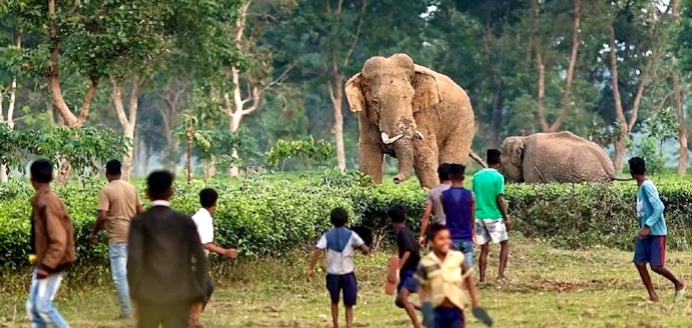
As a small, biodiverse state with high population density, Kerala, has been witness to increasing human-animal conflicts. Multiple instances of wild boars and elephants coming into contact with people living near forest areas have been reported. This has caused both loss of human and animal life and damage to farmland.
Chief Justice Jamdar pointed out that those who are affected in the State are often from the most vulnerable sections of society.
“Those who bear the brunt of this conflict are generally members of vulnerable sections of society – tribals and vulnerable communities. They are also entitled to the protective umbrella of the Legal Services Authority Act,” Justice Jamdar said.