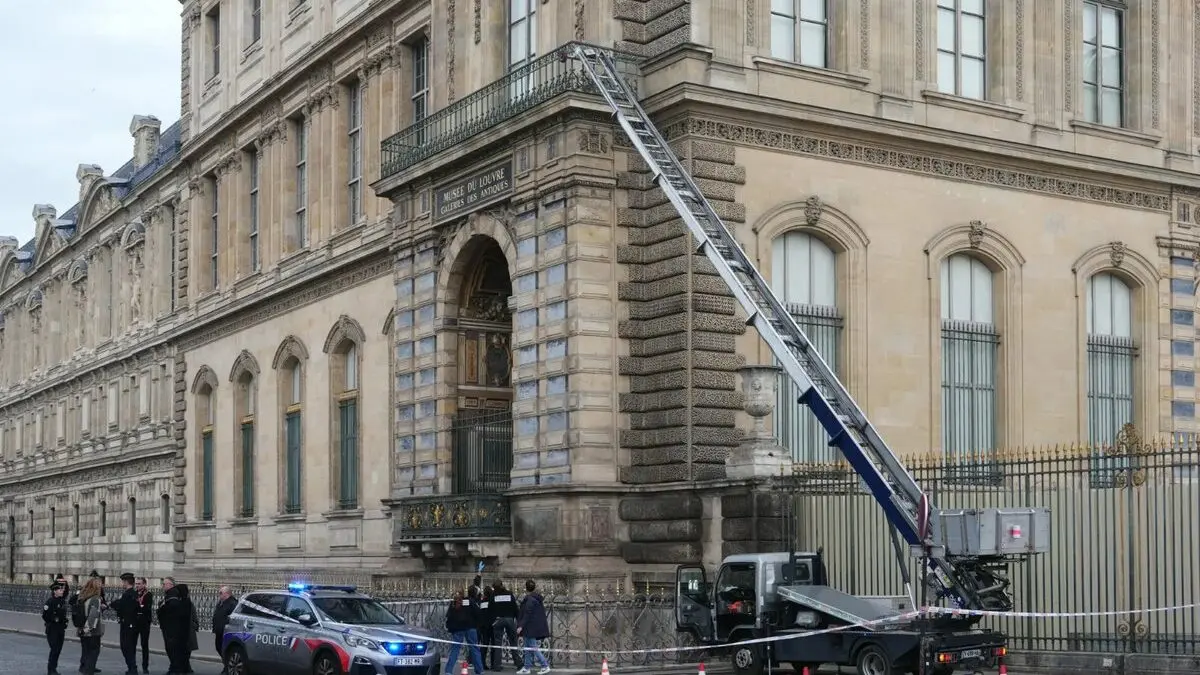
Paris: The world-famous Louvre Museum in Paris reopened on Wednesday three days after a brazen jewellery heist that has left France reeling.
The robbery, carried out in daylight, saw thieves make off with historic royal jewellery from the museum’s Galerie d’Apollon collection, valued at approximately €88 million (about US$102 million) according to the Paris public prosecutor’s office.
What happened
The theft took place early on Sunday morning at about 9:30 a.m., while the Louvre was open to visitors.
Four individuals, described by investigators as a professional team, gained access via a truck-mounted lift (a “basket” or “monte-meuble”) at the museum’s Seine-facing side. They used the lift to reach a second-floor window and entered the Galerie d’Apollon.
The actual raid lasted roughly six to seven minutes. During that time the thieves used angle grinders or disc cutters to break a window and display-cases, threatened guards (though unarmed), and removed eight pieces of jewellery. A ninth object was targeted but not taken, according to the prosecutor.
One of the items targeted — the crown of Empress Eugénie — was dropped during the escape and was later recovered in a damaged condition.
After the raid, the thieves fled on motor-bikes, escaping via the streets around the Louvre.
Significance & aftermath
The Louvre is the world’s most-visited museum, with millions of visitors annually; the fact such a bold heist could be carried out inside its walls has provoked a national and international outcry.
French ministers described the raid as “an attack on our heritage”. The Justice Minister said the incident was “an unbearable humiliation” for France.
Security across major cultural institutions in France has been re-examined in the wake of the robbery, with immediate checks launched at other museums.
From a heritage-perspective, prosecutors emphasised that the economic loss (€88 million) is dwarfed by the damage to France’s historical and cultural legacy.
Re-opening of the Louvre
On Wednesday, the museum reopened its doors to the public, three days after the theft. Live visuals showed visitors walking through the entry gates as normal operations resumed.
In the interim the museum had been closed to allow forensic teams and law-enforcement personnel to inspect the scene, preserve evidence and review security protocols.
The thieves apparently had planned their operation, choosing the early hours of museum opening when visitor volume might still be manageable. The raid took only minutes.
The tool-signature (angle grinders, disc cutters) and method (use of a furniture lift/monte-meuble) suggest a high level of sophistication and planning.
One of the stolen pieces had previously belonged to royalty (e.g., Empress Eugénie; Queen Marie-Amélie; Queen Hortense) – emphasising not just monetary but historical value.
Experts are warning that once such items enter the black-market chain they may be altered, dismantled or melted — reducing chances of recovery significantly if not found quickly.
France’s law-enforcement agencies are continuing their investigation into the heist, looking at surveillance footage, escape routes, and whether the thieves belong to an organised crime group. The speed of the operation is particularly concerning, as is how the security systems at a landmark institution were circumvented.
The museum’s re-opening is a signal of resilience, but the incident has reignited debate about balancing access to cultural treasures with the necessity of guarding them.