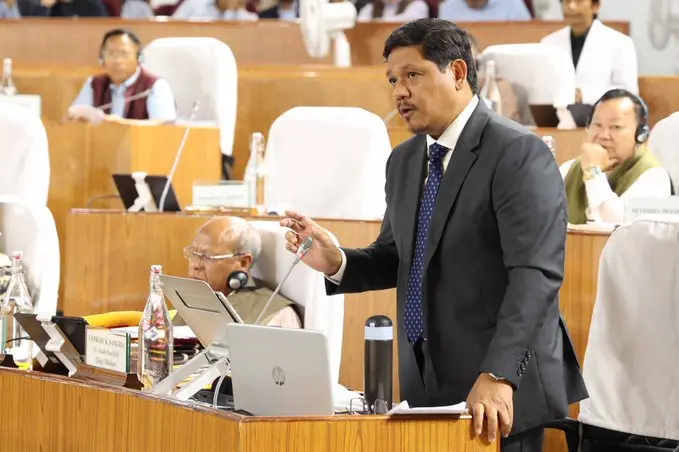
Shillong: The Meghalaya Assembly on Wednesday unanimously passed a resolution opposing uranium mining and any proposal to establish a uranium ore-processing facility anywhere in the state, with all 60 MLAs backing the move, Hindustan Times reported.
Chief Minister Conrad K Sangma moved the resolution, describing the unanimous vote as a “historic and significant moment” for Meghalaya. He said the decision reflected the long-standing concerns of communities in uranium-bearing areas, including Domiasiat, Wahkijn and Lostoin.
Speaking after the resolution was adopted, Sangma said the vote sent an “unequivocal message” that Meghalaya did not want uranium mining or a uranium ore-processing facility. He said the state government would communicate the Assembly’s decision to the Centre and urged it to respect the sentiments of Meghalaya’s tribal communities.
The resolution gives legislative weight to a decades-old opposition to uranium mining in the state. The resistance has involved traditional institutions, student organisations, civil society groups and communities living in areas where uranium deposits have been identified.
A key part of Meghalaya’s opposition is its distinctive system of land ownership. Large parts of the state are governed through private, clan and community ownership, with customary institutions playing an important role in determining how land is controlled and used.
Sangma argued that Meghalaya’s Sixth Schedule protections and customary landholding system could not be disregarded while taking decisions on natural resources, including minerals.
The state government also referred to the Supreme Court’s 2019 judgment in State of Meghalaya vs All Dimasa Students Union. The judgment recognised that, in Meghalaya’s hill districts, private and community landowners have rights over both the surface and sub-soil of their land, including minerals, subject to statutory regulation.
The ruling has particular significance for mining proposals in Meghalaya as it held that minerals beneath privately or community-owned land vest with the respective owners rather than automatically with the state. It also established that a mining lease involving privately owned minerals cannot be granted without the authority of the private or community owner.
With the unanimous resolution, Meghalaya’s political leadership has now formally reiterated its opposition to uranium mining and processing in the state, putting the issue before the Centre and reinforcing the position long maintained by local communities and traditional institutions.