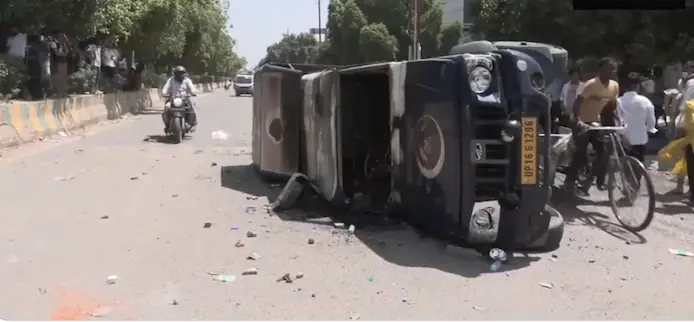
Noida: Workers have taken to the streets not just in Noida but across several industrial cities in India, as a growing mismatch between minimum wages and the cost of living, combined with sharp regional disparities in pay.
From Haryana’s Manesar and Panipat to Gujarat’s Surat and even Bihar’s Barauni, thousands of workers —many of them migrants — have been pressing for parity with recent hikes in neighbouring areas and relief from soaring costs of essentials in recent months.
Protests Beyond Noida
Noida, one of Asia’s largest planned industrial townships housing thousands of manufacturing units, saw protests over minimum wages, which turned violent on its fourth day, with vehicles torched and stones pelted in parts of the satellite city. While over 300 individuals have been arrested and seven FIRs registered, the incident has triggered a wider debate on working conditions and pay structures in major industrial zones such as Gurgaon, Noida, Sonipat and Surat.
In recent months, similar agitations have erupted in Barauni (Bihar), Surat (Gujarat), and Manesar and Panipat (Haryana), where workers have demanded higher minimum wages, better overtime compensation, and safer factory environments. These have been linked, in part, to lower‑than‑expected wage hikes after the implementation of the Labour Codes in November 2025, even as prices of essentials continue to climb.
LPG Squeeze And Migrant Worker Crisis
With India importing roughly 60 per cent of its liquefied petroleum gas (LPG), the US‑Iran conflict and related disruptions have driven up black‑market cylinder prices. The government has promoted smaller 5‑kg cylinders and expanded piped natural gas (PNG) connections, but these are largely confined to formal housing societies, leaving most migrant workers dependent on costly LPG in the informal sector.
In February, around 30,000 contractual workers at Indian Oil Corporation’s Panipat refinery staged a protest over wages and working conditions that turned violent, with stones hurled at security personnel and vehicles damaged. Just days later, nearly 5,000 contract workers on the ArcelorMittal‑Nippon Steel (AM/NS) project site in Hazira, Surat, held another agitation that escalated into clashes, injuring several policemen and leading to vehicles being torched.
Wages Lagging Behind Inflation
Data analysis by The Times of India showed that while minimum wages for unskilled workers in Noida and Ghaziabad have risen by about 42 per cent since 2016, hikes in Delhi, Gurgaon and Faridabad have approached 90 per cent over the same period. Between October 2016 and now, the monthly minimum wage for unskilled workers in shops and establishments in Uttar Pradesh has climbed from Rs 7,936 to Rs 11,314 —a 42.6 per cent increase — while prices in Ghaziabad and Gautam Buddha Nagar, as measured by the CPI‑IW, have risen by 51.3 per cent.
In real‑incomes terms, wages have effectively eroded.
In Haryana, the unskilled minimum wage increased from Rs 8,070 to Rs 11,274 in July 2016, a 40 per cent rise, while inflation in Gurgaon and Faridabad during that period stood at 52.7 per cent and 48.1 per cent, respectively. After fresh protests in Manesar’s industrial belt, the state in April raised the wage to Rs 20,000, an 88.6 per cent jump compared with 2016. Delhi, at Rs 18,456, now has the highest minimum wage in the NCR region, with inflation there at 43.7 per cent.
Hike Accepted, But Discontent Lingers
Addressing the Noida unrest, the Yogi Adityanath‑led UP government raised minimum wages for Gautam Buddha Nagar and Ghaziabad. Unskilled workers now get Rs 13,690 per month, up from Rs 11,313, while semi‑skilled and skilled workers receive Rs 15,059 and Rs 16,868, respectively. Yet, many workers remain unsatisfied. Tularam, who works at a sports‑goods factory in Phase 2, Noida, told The Times of India that he earns Rs 13,000 a month for 12‑hour shifts from 9 am to 9 pm, with no weekly off. “Any leave results in a salary deduction,” he said.
Wage Hikes Compound Companies’ Cost Pressures
Wage increases may strain corporate profits, which are already under pressure from higher fuel prices and supply‑chain disruptions linked to the US‑Iran conflict. For many manufacturers, especially in labour‑intensive sectors, the combination of rising input costs and expectations of higher wages is creating a tight squeeze on margins.
Executives at several companies, including staffing and talent firms as well as jobs platforms, told The Economic Times that such hikes could translate into substantial additional wage bills, particularly in regions already dealing with labour shortages. “Of these three industries, textile factories are largely non‑compliant with wage rates and have difficult working conditions, with mostly women workers made to work 12 hours a day, 30 days a month,” a senior industry executive, who did not wish to be quoted, said.