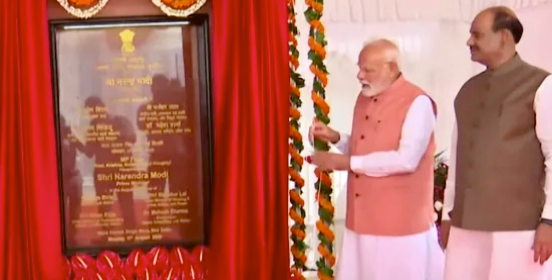
New Delhi: Prime Minister Narendra Modi, on Monday, inaugurated 184 newly constructed Type-VII multi-storey flats for Members of Parliament (MPs) at Baba Kharak Singh Marg in New Delhi.
The Prime Minister also planted a Sindoor sapling at the premises and interacted with ‘shramjeevis’ – the workers who helped build the flats.
The four towers in the complex have been named Krishna, Godavari, Kosi and Hooghly – after four major rivers of India.
Modi did not let go the opportunity to take a jibe at the Opposition on the names of the towers.
“The names of these four towers are very beautiful – Krishna, Godavari, Kosi and Hugli – four major rivers of India that give life to crores of people. These names will give inspiration to our representatives also. However, some people might have a problem with the name of River Kosi. They will see the Bihar elections in this name. I would like to tell these people with small hearts that the tradition of the river names ties us together for the country’s unity,” he said.
Congratulated the MPs for the newly constructed housing complex, which he said would provide ‘ease of living’ for the public representatives, Modi also praised and expressed gratitude to the ‘shramjeevis’ (construction workers) who were involved in the project.
“These big complexes have a financial angle as well. Recently, during the Kartavya Bhavan inauguration, I mentioned that the rent of the ministries which were running in the rented buildings used to be around Rs 1.5 crore per annum. This was a waste of the country’s money. Similarly, due to the unavailability of government residences, the government spending used to increase,” he said.
“Despite this shortage, from 2004 to 2014, not even a single resident was built for the Lok Sabha MPs. That is why we took it up as a campaign. Since 2014 to date, along with these flats, around 350 residences have been made for the MPs. This also saves the country’s money,” Prime Minister Modi added.
Among those present were Lok Sabha Speaker Om Birla, and Union ministers Manohar Lal Khattar and Kiren Rijiju.
The complex has been designed to be self-sufficient and is equipped with modern amenities to meet the functional needs of MPs. It incorporates green technology, adheres to the GRIHA 3-star rating and complies with the National Building Code (NBC) 2016, according to a government press release.
Officials said that the sustainable features will help conserve energy, generate renewable power and improve waste management.
The buildings were constructed using monolithic concrete with aluminium shuttering – a method said to speed up completion while ensuring durability. The premises are Divyangjan-friendly and include earthquake-resistant structures. A robust security system has also been put in place.
Each flat provides space for both residential and official work, with dedicated areas for offices, staff accommodation and a community centre. Officials said vertical development was necessary given the limited availability of land, with the aim of reducing maintenance costs.
Located close to the Parliament House Complex, the site offers what the government described as “significant locational advantages” for MPs.