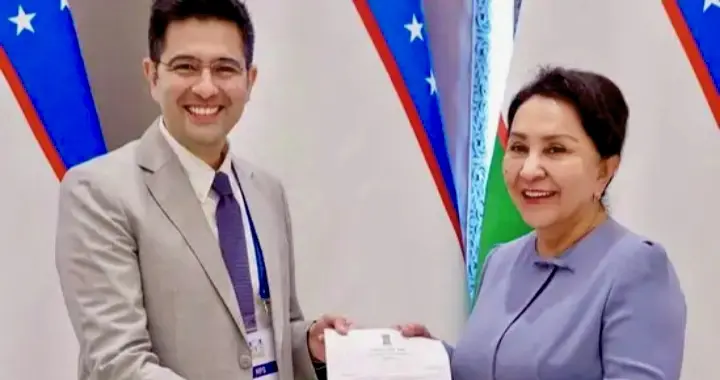
Samarkand: BJP leader and Rajya Sabha MP Raghav Chadha, highlighted India’s Unified Payments Interface (UPI) as a model of digital inclusion, while speaking at the 12th Inter-Parliamentary Union (IPU) Global Conference of Young Parliamentarians in Uzbekistan.
UPI’s integration with Uzbekistan’s UZQR system will allow Indian travellers to make direct payments from their bank accounts by scanning QR codes at shops, Chadha said.
This facility comes shortly after Uzbekistan announced a 20-day visa free travel on that country for Indian nationals.
Chadha was nominated to represent the Parliament of India at the 12th Inter-Parliamentary Union (IPU) Global Conference of Young Parliamentarians, held at Samarkand in Uzbekistan.
The MP, during his speech, highlighted India’s belief that digital rights rest on four pillars, identifying these as access, agency, safety and opportunity. The Union government had launched the Digital India Initiative in 2015 with the “belief that technology must be a bridge and not a divider”, he said, as reported by Hindustan Times.
“Today, the cost of 1 GB of data has fallen from Rs. 269 in 2014 to just Rs. 8 per GB. That is a reduction of 97%,” the BJP leader said.
In the context of agency, the payment system “belongs to no bank or technology company”, he said.
“The clearest example of that, as I said, is India’s UPI. When it was started in 2016, UPI had only 90,000 transactions in its first month and in the last financial year, that is 2025-26, UPI processed more than 240 billion transactions worth ₹314 trillion,” Chadha said.
He also spoke about safety, while underscoring the Supreme Court ruling on privacy being a fundamental right and the Parliament enacting the Digital Personal Data Protection Act.
On opportunity, the MP said young people will skills and technology, “become creators, innovators and leaders”.
“The test of this era will not be how clever our machines have become, it will be whether the young women with the cheapest phone in the poorest district gets the same data protection, same data access and the same digital rights as everybody else,” Chadha said.