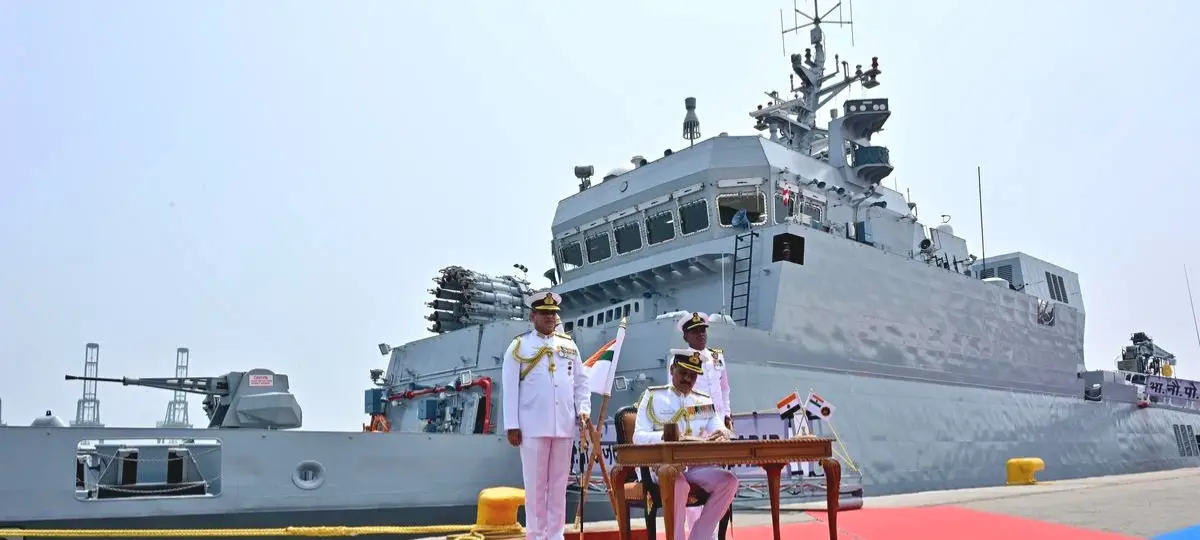
Chennai: The Navy is set to induct 15 warships this year with the aim to expand its operational footprint across the Indian Ocean region and beyond, Admiral Dinesh Tripathi, Chief of the Naval Staff said during the commissioning ceremony of the new Anti-Submarine Warfare Shallow Water Craft (ASW SWC) INS Anjadip at Chennai on Friday.
These warships will include four Nilgiri class guided missile frigates, more ASW SWCs and a diving support vessel for the west coast to be named as INS Nipun.
“In 2025, the Indian Navy commissioned 12 warships and one submarine. This momentum continues with plans to induct about 15 more ships in 2026, setting an unprecedented benchmark and marking the highest rate of induction in our history,” Admiral Tripathi said.
“Beyond the numbers, our focus has been on sharpening critical war-fighting capabilities – particularly in anti-submarine and under-sea warfare. The platforms inducted over the past year are equipped with highly advanced and sophisticated ASW capabilities,” he added, as reported by Deccan Herald.
The enhancement of anti-submarine capabilities, particularly closer to the country’s coastline, comes at a time when Pakistan is preparing to induct the first of its eight Hangor class diesel-electric submarines, built under a China-Pakistan cooperation programme. The vessel is likely to enter the service by mid 2026 and all of them
are to be commissioned by 2028 by the Pakistan Navy.
Increased submarine activity by the People’s Liberation Army Navy (PLAN) of China has also been reported in the Bay of Bengal.
While the Navy has four anti-submarine warfare corvettes, the 16 ASW SWCs that it will receive by the end of 2028 will add punch to its capabilities. The Navy also uses its P8I long range surveillance aircraft to track submarines.
The 16 ASW SWCs are being built (eight each) by Garden Reach Shipbuilders and Engineers (GRSE) Ltd and Cochin Shipyard Ltd (CSL). While there of these warships – INS Arnala, INS Androth and INS Anjadip – have already been delivered by GRSE and commissioned into the Navy, the first one by CSL – INS Mahe – has also joined the force.
Four Nilgiri-class frigates are also likely to be inducted in 2026, beginning with INS Taragiri that will be commissioned on March 14 at Visakhapatnam.
The Red Sea crisis showed how disruption at a single choke point could ripple across continents as freight rates on key Asia-Europe routes surged – in some cases by as much as 300-350% – impacting supply chains and driving up food and fuel costs, Admiral Tripathi said.
“The ongoing tensions in the Strait of Hormuz – a vital global energy corridor – have also reflected this reality. Even a precautionary closure of the strait for live-fire exercises last week, led to Brent crude prices rising by about 4.4 % in a single trading session, reaching their highest level in weeks,” he said.
The Indian Navy’s deployment in the Red Sea since October 2023, even in such a complex and sensitive security environment, enabled the safe transit of nearly 400 merchant vessels, carrying approximately 16.5 million metric tonnes of oil and cargo, worth over 7 billion US dollars bound for India.