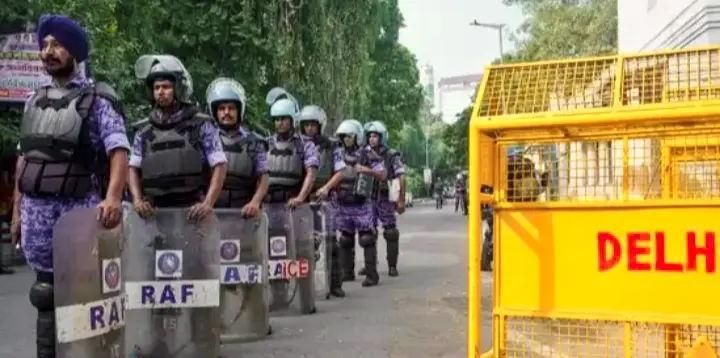
New Delhi: In the evolving digital media era, there is a need to ascertain if “reel makers” and “content creators” can be elevated to the status of journalists, the Delhi police has told the Supreme Court.
This assertion was made by the in an affidavit filed on Tuesday in response to petitions by journalist organisations and associations complaining against excesses and misconduct by police personnel during the anti-CEC protests held in the Capital last month.
“In the present era of evolving digital media, several individuals, whether creative or otherwise, make reels, upload them and commercially exploit the content created by them. While there can be no objection to such activities, the question as to whether such reel-makers can be elevated to the status of journalists or reporters is yet to be determined,” the affidavit, filed by Joint Commissioner of Police Surender Kumar, said, as reported by Hindustan Times.
The response was filed in a batch of petitions by the Network of Women in Media, India (NWMI), Free Speech Collective, Delhi Union of Journalists, and Kerala Union of Working Journalists ahead of next week’s hearing in the case.
The police exercised utmost restraint and resorted to minimum force against journalists covering the protest, it said.
The police have cited videos circulated on social media in which certain individuals identifying as “media personnel” were seen participating in the protests, raising slogans alongside the protesters, clearly suggesting they were not journalists.
“Such conduct indicates that some of these individuals were participating in the protest and were not at the spot in their capacity as journalists,” the affidavit said.
Stating that it fully respects the role of the press, the police submitted that “some of the protesters who participated in the illegal protest were not journalists, but were using a camera and a microphone, falsely claiming to be journalists.”
There were many “content creators” for YouTube reels, with cameras and microphones during the protests, making it difficult to distinguish between journalists and reel makers, it said. However, such reel makers were not obstructed or hindered except in cases where maintenance of public order and law and order was required, the police said.
The police has denied allegations of the use of brute force against journalists. “Throughout the said period (of protest), the Delhi Police exercised the utmost restraint and resorted only to the minimum force necessary to disperse the prohibited assemblies and to secure compliance with its lawful directions, and the persons so removed from the protest sites were released,” it has been stated.
The document does not deny the fact that some journalists were rounded up. “Some journalists were mistakenly identified as protestors in the absence of conspicuously displayed identification/accreditation. However, the moment the journalistic credentials of any person were ascertained, such a person was immediately released,” the affidavit says.
The police categorically denied that, at any point, it sought to “obstruct, impede or interfere” with the discharge of journalistic duties, and that the directions for crowd control issued during the protests were intended to protect journalists in the discharge of their professional duties.
“It does not, and was not intended to, exempt the so-called reel-makers and social media influencers or unruly elements from the operation of the general law or from compliance with the lawful directions of the law enforcement agencies at the site of a prohibited assembly,” it added.
Sharing several photographs and videos from the protest sites published and broadcast by international, national and regional media houses, the police said that it “belies” the allegation that the press was prevented from witnessing and reporting the events.
“At no point was there any deliberate or concerted action on the part of the Delhi Police to obstruct, restrict or interfere with journalists who were lawfully discharging their professional duties,” the response stated.
Further, no journalist was detained in any of the cases registered or in the entries recorded at the police stations of the New Delhi District during the CJP protest, and no equipment or articles belonging to any journalist were ever seized, it added.
The police also defended its advisory requiring journalists to wear their accreditation or employment cards, saying that, by doing so, it consciously adopted an “inclusive approach” to facilitate journalists in the discharge of their professional duties.
In response to alleged misconduct by male police personnel, the affidavit said: “The mere presence or involvement of male police personnel in crowd-control operations during the CJP protest cannot, in itself, be construed as misconduct, particularly where the circumstances warrant immediate police intervention by the nearest police personnel.”
A total of 3,747 women personnel of the Delhi police and central armed police forces were deployed during the day shift, and 664 during the night shift, with male police officers acting as first responders or assisting a woman police officer in the discharge of her duties, it said.