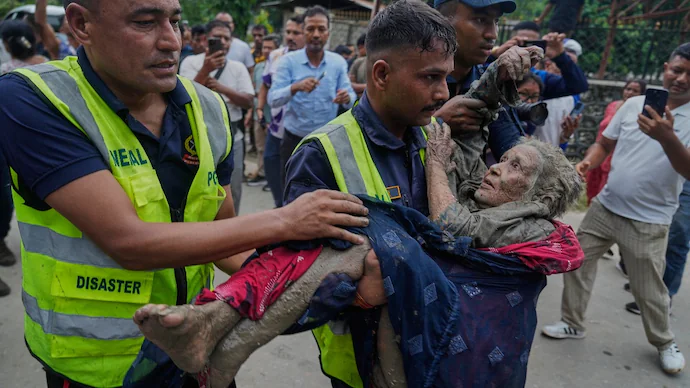
Kathmandu: Wednesday’s flash floods devastated Nepal, washing away human beings, bridges, buildings, cars and everything else that fell in the path of Bhote Koshi and Trishuli rivers after an avalanche along the Nepal-Tibet border triggered a massive surge of water, sediment and boulders.
The official death toll has crossed 500 and more than 1,000 are missing or unaccounted for, including around 300 Indians.
Nepal is receiving foreign assistance in the form of relief supplies and financial contributions from numerous countries, including 47.5 tonnes of Humanitarian Assistance and Disaster Relief (HADR) material already.
However, the Balen Shah-headed government has declined offers from several countries to deploy specialised search-and-rescue teams, saying its own security forces are equipped to carry out the ongoing operation, The Kathmandu Post reported.
According to a senior official of Nepal’s Foreign Affairs ministry, formal and informal requests have been coming from several governments and organisations seeking to send rescue personnel.
Officials from India, China, the United States, the United Kingdom, Japan, South Korea, Sri Lanka and Bangladesh had sought permission to send teams.
The Indian government had offered to send teams from its National Disaster Response Force (NDRF), only to be told not to.
The reason why those requests were turned down by the Nepalese government was because of past experience. It was based on recommendations by the Nepali Army and police, drawing lessons from the deadly earthquake which devastated the Himalayan kingdom in 2015.
The large number of international search-and-rescue teams that arrived after that disaster created considerable challenges in coordinating and managing relief operations, according to the official.
Nepal’s experience after the April 2015 earthquake was central to the decision, according to the senior foreign ministry official quoted by The Kathmandu Post.
That earthquake led to a massive international response, with rescue contingents, military aircraft and relief organisations arriving from across the world. The sudden influx also created serious logistical and administrative pressure.
Competition among foreign contingents and difficulties coordinating their movements complicated management at a time when airports, roads and communication networks were already under strain.
Kathmandu wants to avoid a repeat by sticking to a Nepali chain of command rather than accommodating several independently operating foreign rescue teams.
As India’s Ministry of External Affairs spokesperson Randhir Jaiswal said, “Whatever request has been made by Nepal, we are acting on that.”
Indians account for maximum number of foreign nationals still unaccounted for. In all, there are around 550 foreign nationals from 31 countries who are untraceable following the catastrophic floods which also affected Tibet.