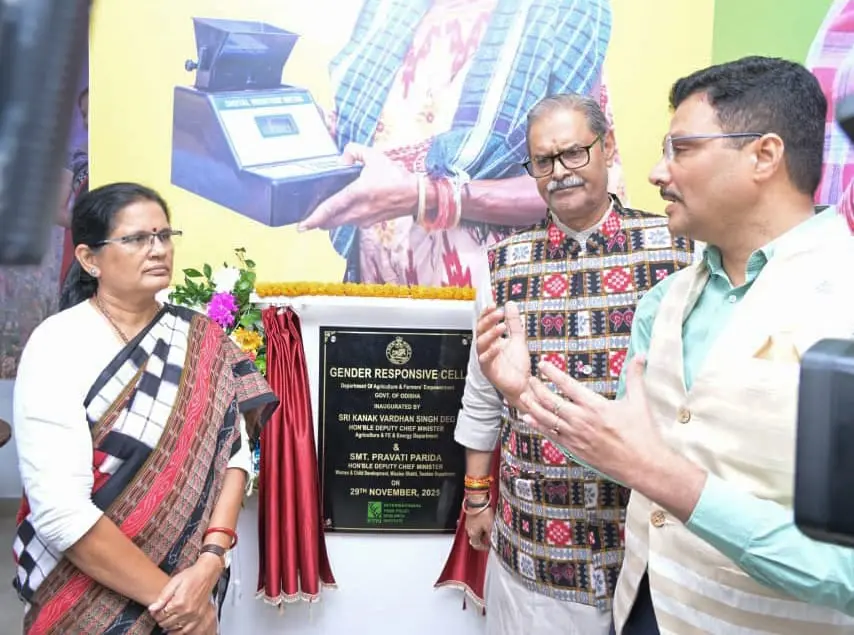
Bhubaneswar: A Gender Responsive Cell (GRC) was launched at Krushi Bhawan on Saturday, in collaboration with the International Food Policy Research Institute (IFPRI).
It marks a significant step towards embedding gender equity into Odisha’s agricultural governance systems.
Deputy Chief Minister Kanak Vardhan Singh Deo, who inaugurated the GRC with fellow-deputy CM Pravati Parida, said that its launch strengthens Odisha’s long-standing commitment to inclusive agricultural development.
“Odisha has always championed progressive agricultural reforms, and the launch of this Gender Responsive Cell reflects our resolve to make agricultural governance more inclusive, evidence-led, and responsive to the needs of women farmers. As women constitute a significant share of our agricultural workforce, we must ensure they have equitable access to schemes, technologies, markets, and opportunities,” Singh Deo stated.
Parida highlighted the broader significance of launching the GRC, at a time when the
world prepares to observe the UN International Year of the Woman Farmer in 2026.
“As we approach the UN International Year of the Woman Farmer, this launch of an exclusive GRC shows our commitment for the women of our state and becomes even more meaningful when our state takes such initiative prior to the international year. The GRC begins its operations at a moment when global attention is turning to the challenges women farmers face and the urgent need for more inclusive systems. By embedding gender responsiveness into our governance structures, the Cell will help address gaps in access, participation, and benefits,” Parida said.
Dr Arabinda Kumar Padhee, Principal Secretary to the Odisha government, Department of Agriculture and Farmers’ Empowerment, said that the GRC will help in systematically applying a gender lens across planning, budgeting, service delivery and monitoring.
The GRC, conceptualised as an innovative institutional mechanism embedded within DAFE, will strengthen gender equity across the full cycle of governance.
The Cell will serve as an analytical hub, supporting policy assessments, gender-responsive budgeting, and data-driven decision-making while creating frameworks that can be adapted across departments.
Dr Shahidur Rashid, IFPRI’s South Asia Regional Director, reaffirmed the institute’s support for the state as a long-term technical and knowledge partner.