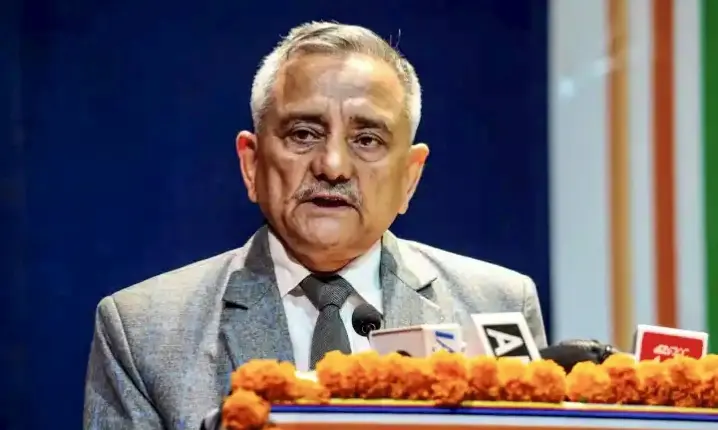
New Delhi: Pacts signed by Pakistan may give Islamabad overconfidence and it may make another “miscalculation”: regarding its capabilities, former Chief of the Defence Staff (CDS), General Anil Chauhan (Retd) has said.
Pakistan will remain “a major security concern and a threat for times,” while also outlining other actors that may pose a threat to India.
Gen Chauhan (Retd), was delivering the 22nd Bharat Ratna Pandit Govind Ballabh Pant Memorial Lecture at the Prime Ministers’ Museum and Library at Teen Murti Bhawan, New Delhi, on Saturday.
The former CDS flagged several emerging challenges to India’s national security, including shifting geopolitical alignments, rapid technological change, evolving forms of warfare, and the use of information as a weapon. He commented on Pakistan, Saudi Arabia and Turkiye joint defence agreement, and said that such pacts induce “overconfidence” in Islamabad and it may make another “miscalculation”, WION reported.
“We’ve also seen some kind of agreements and accords which they have recently signed. This sometimes, I feel, may induce some kind of an overconfidence into Pakistan, and they may make some kind of a miscalculation again. We’ve got to be careful about that,” the retired general said.
Operation Sindoor, holding of Indus Water Treaty in abeyance and some practical measures may “hopefully change or induce behavioural change in our neighbour”, he said.
General Chauhan (Retd) coined a word “cognitive colonialism” and explained it as an attempt to influence how societies understand themselves, form values, place trust, and imagine their future, effectively targeting the human mind rather than territory or infrastructure.
India’s response must rest on strengthening national capacity across both traditional and emerging domains, he argued. He linked security to broader nation-building, emphasising that strong institutions, foresight to anticipate threats, and an engaged citizenry are essential pillars.
“India’s external threat environment is shared by large number of factors, unresolved borders… cross-border terrorism, non-state actors, contested spaces which are known as global commons, then expanding cooperation and competition in space, cyber and the maritime domain. These factors interact. They cannot be examined in separate compartments; they have to be looked at in one (perspective),” he said.
“Let me talk about our western neighbour. So Pakistan will remain, I think, a major security concern and a threat for times to come,” the former CDS cautioned.
The “old kind of warfare” that countries were used to fighting no longer holds, he said, calling it “a different kind of war.”
The threat from China is different, Gen Chauhan (Retd) said, adding that it is “distinctly different, longer-term and more complex.”
He pointed out that the boundary issue remains unresolved, with no mutually agreed definition even of the Line of Actual Control, adding that differing perceptions, combined with ongoing infrastructure development on both sides, create the potential for friction and tension.