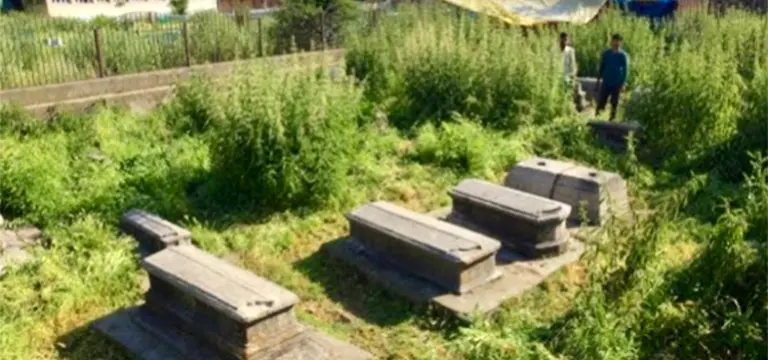
Srinagar: The fake narrative created by separatists of unmarked graves in north Kashmir belonging to those killed in so-called ‘atrocities’ by the security forces has finally been busted, thanks to a field study conducted by an NGO from the state.
The study has revealed that more than 90 per cent of the 4,056 unmarked graves investigated belong to foreign and local terrorists.
For years now, separatists have been peddling the theory of ‘mass graves’. Security forces allegedly killed innocent Kashmiris for mere dissent and dumped their bodies in unmarked graves.
The report, titled ‘Unravelling the Truth: A Critical Study of Unmarked and Unidentified Graves in Kashmir Valley’, based on the study conducted by the Kashmir-based NGO Save Youth Save Future Foundation (SYSFF) has dispelled this theory for good.
Researchers led by Wajahat Farooq Bhat, Zahid Sultan, Irshad Ahmed Bhat, Anika Nazir, Muddasir Ahmed Dar and Shabir Ahmed physically inspected and documented 373 graveyards across the border districts of Baramulla, Kupwara and Bandipora in north Kashmir and Ganderbal in central Kashmir.
“The organisation, which is funded by people, started this project in 2018 and completed the groundwork in 2024. After that, we were preparing the report for submitting to various government offices. The report can stand testimony to counter any narrative that is being dictated from across the border to spread panic in the Kashmir valley,” Farooq Bhat said.
Using a rigorous methodology that included GPS tagging, photographic documentation, oral testimonies and an analysis of official records, the study aimed to provide evidence rather than relying on unverified accounts.
The research team documented a total of 4,056 graves, with the data revealing a reality that debunks claims made by the separatists.
The report reveals that as many as 2,493 graves (approximately 61.5 per cent) were identified as belonging to foreign terrorists who were killed in counter-insurgency operations. It noted that these individuals often lacked identification to conceal their networks and maintain Pakistan’s plausible deniability.
Nearly 1,208 graves (approximately 29.8 per cent) belonged to local militants from Kashmir who were killed in encounters with security forces. Many of these graves were identified through community testimonies and family acknowledgements.
The researchers found only nine confirmed civilian graves, a mere 0.2 per cent of the total.
This finding, according to the SYSFF, directly contradicts the claims of civilian mass graves and suggests that allegations of systematic extrajudicial killings have been “significantly overstated”.
The study also identified 70 graves of tribal invaders who died during the 1947 Kashmir war, highlighting the historical depth of conflict-related burials in the region.
Bhat emphasised the need for a comprehensive forensic investigation of the 276 genuinely unmarked graves using modern DNA testing to address humanitarian concerns.
The report further said the field investigation community engagement formed a crucial component of the research methodology, involving semi-structured interviews with a diverse cross-section of stakeholders. These include local clerics and members of Auqaf mosque committees, gravediggers with decades of experience, families of local militants and disappeared persons, long-term residents with knowledge of local burial practices and former militants who had surrendered or were released.
The SYSFF report argues that its findings reveal such characterisations are largely unsupported by ground evidence. Bhat has called on the international community to demand systematic verification of such claims before making policy decisions.
The study attributes the surge in burials between 1990 and 2000 to the influx of foreign militants following the Soviet withdrawal from Afghanistan, a period that fundamentally altered the nature of the Kashmir conflict.
The group, which mainly comprises scholars studying in various universities, said that following the Soviet withdrawal from Afghanistan in 1989, Pakistan’s Inter-Services Intelligence and military establishment redirected their resources and expertise towards Kashmir, viewing it as the next front in their strategic competition with India.
“This shift introduced foreign militants, sophisticated weapons, radical ideologies and external funding that fundamentally altered the character of the Kashmir conflict. Groups like Hizbul Mujahideen, Lashkar-e-Taiba and Jaish-e-Mohammad gained prominence during this period, bringing with them agendas that extended far beyond traditional Kashmiri political aspirations,” the researchers said.
It said the influx of foreign militants created unprecedented security challenges for the security forces, who found themselves confronting well-trained, heavily armed infiltrators operating without local identification or family connections.
Bhat said he and his colleagues grew up in an environment where mass graves were being projected as a reality.
“For once, we decided to find it by ourselves what the truth is and the findings directly contradict claims of widespread civilian mass graves and suggest that allegations of systematic extrajudicial killings resulting in mass anonymous burials lack empirical foundation,” the group said.
The study also highlights Pakistan’s moral and humanitarian responsibility to acknowledge its citizens among the foreign militants buried in Kashmir and to facilitate family visits to these graves in accordance with international humanitarian norms.
“The systematic denial and abandonment of these individuals by the Pakistani state represents a significant humanitarian failure that has prolonged the suffering of both Kashmiri communities who have borne the burden of caring for these graves and Pakistani families who may never know the fate of their relatives,” the report said.