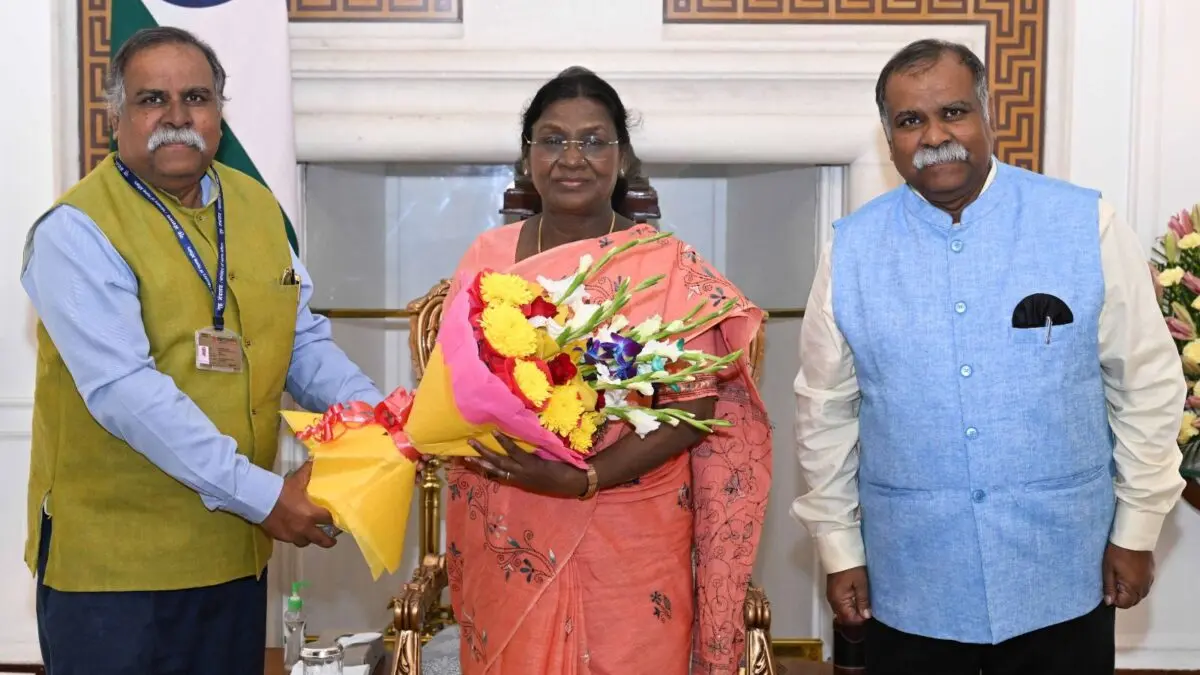
New Delhi/Bhubaneswar: Chairman National Monuments Authority Kishor Basa and his twin brother Ashok Basa, Chair of the Strategic Planning Committee, World Federation of Engineering Organizations (WFEO), and former president of Institution of Engineers (India), called on President Droupadi Murmu at Rashtrapati Bhavan in New Delhi on Tuesday.
During the meeting, Kishor Basa apprised the President regarding issues related to cultural and tribal development of Odisha and urged her to take steps for the establishment of a National Institute of Tribal Development (NITD) at Rairangpur in Mayurbhanj district.
The proposed institute may be set up under the Ministry of Tribal Affairs, considering the strategic location of Rairangpur as well as concentration of tribal population of Odisha as well as neighbouring Jharkhand and West Bengal. He suggested that the Institute may be modelled after the National Institute of Rural Development in Hyderabad.
He also sought the attention of Murmu to the need for cultural preservation of the Jhumar song and dance form, recognised as an important Intangible Cultural Heritage. Jhumar symbolises a cultural integration of tribes and castes in the major geographical region extending from Odisha, Chhattisgarh, Jharkhand to West Bengal and Assam. Kishor Basa stressed the need for recognition of this song and dance form by establishing a National Centre for Jhumar at Baripada, Mayurbhanj under the Ministry of Culture. He also sought steps for bringing the Archaeological Museum at Khiching under the Archaeological Survey of India for better preservation, display and promotion. At present, the Museum is functioning under the government of Odisha.
During the meeting, Ashok Basa apprised the President about the issue of global scarcity of water. He submitted that the United Nations Organization (UNO) has already launched the ‘Water Action Decade 2018-2028’, in addition to keeping the role of water in Sustainable Development Goal (SDG) 6,11,13 and 14.
Ashok. Basa stressed that India is facing its worst ever water crisis, which would result in 6% loss of India’s GDP by 2050. India’s water demand is projected to be twice the available supply by 2030, which will lead to severe water scarcity. Under these circumstances, he told the President about the need for proper governance for management of water resources of the country.
He also urged the President to take steps for initiating a pilot project on Water Resources Management in Odisha, which would involve creating a State Water Management Authority responsible for restructuring of water policy. Upon successful implementation in Odisha, the same could be replicated in other states. A detailed note in this regard, was submitted by him.