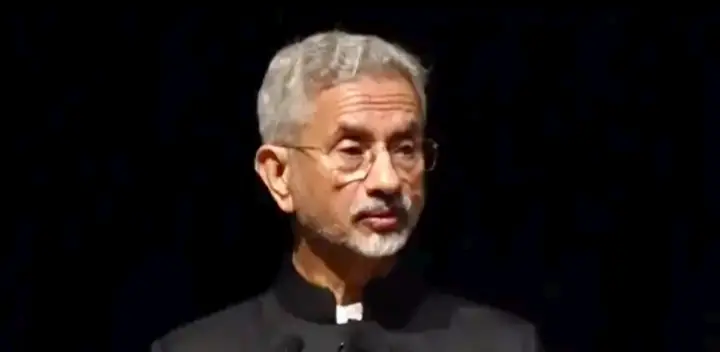
Chennai: India has every right to defend itself against neighbours who support terror while simultaneously seeking cooperation from New Delhi, external affairs minister S Jaishankar said on Friday.
Good neighbourly relations cannot exist with continued acts of terrorism, he said, while referring to Pakistan.
“But when it comes to bad neighbours who persist with terrorism, India has every right to defend its people and will do whatever is necessary. You cannot request us to share our water with you and also spread terrorism in our country,” Jaishankar said while addressing an event at IIT, Madras.
India’s neighbourhood policy is guided by “common sense”, the minister said, clearly distinguishing between cooperative neighbours and hostile ones.
“You can also have bad neighbours. Unfortunately, we do. When you have bad neighbours, if you look to the one to the west. If a country decides that it will deliberately, persistently, and unrepentantly continue with terrorism, we have a right to defend our people against terrorism. We will exercise that right. How we exercise that right is up to us. Nobody can tell us what we should or should not do. We will do whatever we have to do to defend ourselves,” Jaishankar said, as reported by News18.
Terrorism is linked with the erosion of trust in regional cooperation, particularly in areas such as water-sharing agreements, he said.
“Many years ago, we agreed to a water sharing arrangement, but if you had decades of terrorism, there is no good neighbourliness. If there is no good neighbourliness, you don’t get the benefits of that goo
d neighbourliness. You can’t say, ‘Please share water with me, but I will continue terrorism with you.” That’s not reconcilable,” Jaishankar added.
The former diplomat contracted this with India’s approach toward friendly neighbours, highlighting New Delhi’s consistent support during crises.
“With good neighbours, India invests, helps and shares – whether it was vaccines during COVID, fuel and food support during the Ukraine conflict, or the USD 4 billion assistance to Sri Lanka during its financial crisis. India’s growth is a lifting tide for the region, and most of our neighbours recognise that if India grows, they grow with us,” the minister remarked.
He went on to speak about India’s broader worldview, referencing the idea of ‘Vasudhaiva Kutumbakam’.
“…When we use this word so casually ‘Vasudhaiva Kutumbakam’, what is actually the messaging of that word of that term? The term is that we have never considered the world as an inimical or a hostile environment from which we have to defensively protect ourselves,” Jaishankar said, adding that Indian diplomacy today focuses on problem-solving by leveraging strengths, competitiveness, and partnerships.
Vaccine diplomacy had an unmatched emotional impact worldwide, the minister said, highlighting India’s global outreach during the COVID-19 pandemic.
“In my entire career, I have never seen anything having a greater emotional impact on the rest of the world than giving vaccines,” he remarked, recalling how many developing and small island nations depended on India when richer countries stockpiled doses.
“India is among the very few ancient civilizations that have survived to become major modern nation-states. We carry a deep sense of our past, inherited through our beliefs, language, and culture. It’s about rediscovering and expressing our own internal tools and creativity, not in an anti-Western way, but a non-Western one,” he said, noting that global diversity would coexist with and reinforce shared democratic values.