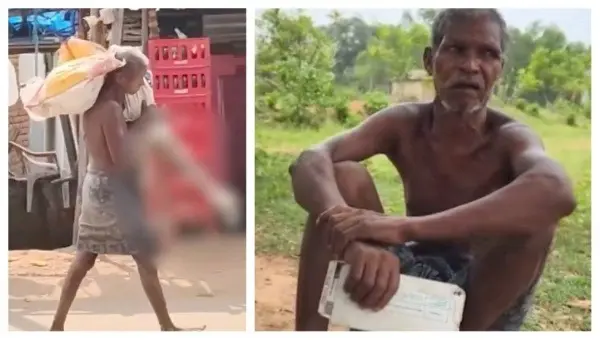
Bhubaneswar: The Revenue Divisional Commissioner (RDC), Northern Division, will begin a detailed inquiry into the shocking incident in Keonjhar district, where a tribal man was forced to carry the skeletal remains of his deceased sister to a bank branch to claim her deposit due to procedural hurdles, on Wednesday.
Chief Minister Mohan Charan Majhi ordered the administrative probe to determine how the situation arose and to prevent any recurrence even as visuals of the tribal man carrying human remains into Odisha Gramya Bank at Malliposhi as proof of her death went viral on Tuesday, exposing a glaring systemic failure. It was a heartrending 4 km trek.
The CMO release further stated that the matter was swiftly resolved, with the bank releasing the funds and the district administration providing additional support, following Majhi’s intervention.
While death and legal heir certificates were issued on a fast-track basis by the medical officer and local authorities., the bank released the full deposit amount of Rs 19,300 to Jitu Munda, his brother Dhaneswar, and sister-in-law at their home in Dianali village in Patna block, about 65 from Keonjhar headquarters town. The district administration also provided Rs 30,000 as immediate assistance from the District Red Cross Fund.
The release further stated that the Chief Minister is deeply pained by the incident. He has advised officials to be more sensitive and empathetic while dealing with common citizens, especially those from marginalised and remote tribal communities, and to simplify access to government and banking services.
According to sources, Jitu had been attempting to withdraw the amount, which his unmarried sister had deposited after selling her oxen. Bank officials had reportedly asked for the account holder or proper proof of death (death certificate), which the 50-year-old tribal man, unfamiliar with bureaucratic procedures, found difficult to understand. Following which, he headed to the bank, seeking to withdraw the deposit, passbook in hand and his sister’s skeletal remains on his shoulder, sparking nationwide shock and outrage.
The incident has drawn parallels to the 2016 Kalahandi case involving Dana Majhi, who carried his wife’s body for 10 km due to lack of transport, once again highlighting challenges of awareness, procedural rigidity, and systemic gaps faced by people living on the margins.
The bank’s sponsor, Indian Overseas Bank, clarified that staff followed standard procedures to protect the account holder’s interests and denied any harassment, attributing the situation to a lack of awareness of claim settlement processes. An investigation by the bank’s regional manager also revealed that Jitu had turned up at the bank for the first time on Monday and the CCTV footage showed him in an inebriated state. When he sought to withdraw the deposit amount, he was told to bring either the account holder or ‘mrityu praman,’ which translates to ‘proof of death’.
While a complaint has also been filed before the National Human Rights Commission seeking action and compensation for the family, the Keonjhar administration has reiterated its commitment to preventing such situations in the future by enhancing banking and administrative awareness in remote areas.