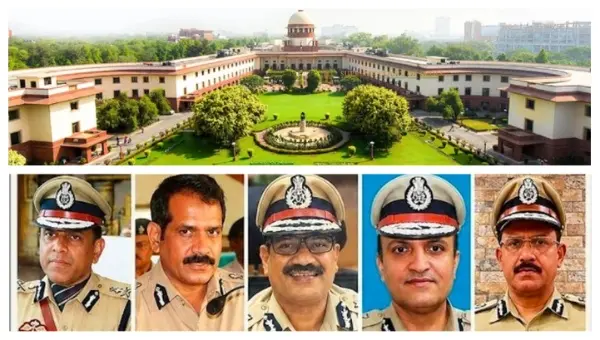
New Delhi/Bhubaneswar: The controversy over the appointment of Odisha’s next Director General of Police is set to come under the Supreme Court’s scrutiny on Thursday, with the landmark Prakash Singh police reforms case listed before a three-judge Bench headed by Chief Justice Surya Kant.
According to the Supreme Court’s Daily Cause List for August 13, W.P.(C) No. 310/1996 — Prakash Singh & Ors. vs Union of India — has been scheduled as Item No. 26 in the Chief Justice’s Court. The Bench, comprising Chief Justice Surya Kant, Justice Joymalya Bagchi and Justice V. Mohana, is due to assemble at 10.30 am.
The listing carries particular significance for Odisha after urgent oral submissions by Senior Advocate P. Chidambaram concerning the process for selecting the state’s next police chief. The core issue before the Court is whether the state’s handling of the selection process conforms to the directions issued in the Prakash Singh judgment, which requires state governments to appoint DGPs from a panel of three senior-most officers empanelled by the Union Public Service Commission on the basis of length of service, service record and relevant experience. Another key question is whether the field of eligible officers can be altered after the selection exercise has already been initiated.
The Court’s approach will be closely watched for any directions that could have an immediate bearing on Odisha’s ongoing process, with wider implications for adherence to the police reforms framework nationwide.
At the centre of the dispute is the handling of the list of eligible IPS officers forwarded by the Odisha government to the UPSC. In April, the state submitted a panel of three DGP-ranked officers — Sudhanshu Sarangi (1990 batch), Susanta Kumar Nath (1993 batch) and R P Koche (1993 batch). In May, this was expanded to 11 officers by adding eight ADG-ranked officers. Allegations have been raised that the state later withdrew its proposal ahead of an earlier UPSC empanelment exercise and that subsequent administrative steps, including last-minute promotions, could alter the pool of officers eligible for consideration. It has also been claimed that the process could facilitate the promotion and subsequent consideration of comparatively junior ADGP-rank officers.
These remain allegations before the Court and have not been judicially established.
On August 10, the Odisha government promoted two 1994-batch IPS officers, Sanjeeb Panda and Yeshwant Kumar Jethwa, to the rank of DGP.
Petitioners contend that such promotions could bring these officers into a revised panel, potentially changing the seniority and eligibility framework. A public interest litigation challenging the process was mentioned by Chidambaram on Tuesday before the same Bench. The Court indicated it expected the UPSC to adhere to its earlier directions and agreed to list the matter, though the PIL itself was not taken up on Wednesday. No stay has been issued on the selection process so far.
Meanwhile, the UPSC’s empanelment committee is expected to reconvene in New Delhi on Thursday to shortlist three officers for the post. The timing is critical as incumbent DGP Y B Khurania, a 1990-batch officer, is due to retire on August 16 after completing his two-year tenure.
According to state government officials, the revised list under consideration includes Sudhanshu Sarangi, R P Koche, Sanjeeb Panda and Yashwant Jethwa. Once the UPSC finalises its panel of three, the Odisha government will select the next DGP from among them in accordance with the Supreme Court’s guidelines.
The converging timelines of the judicial scrutiny, the UPSC meeting and the impending retirement have placed the appointment under intense focus. Any delay could necessitate interim arrangements.